AI Agent Infrastructure in 2026: The Agent-Native Stack Takes Shape
AI Agent Infrastructure in 2026: The Agent-Native Stack Takes Shape
For two years, "AI agents" were mostly applications bolted onto a stack built for humans clicking through apps. In the first week of June 2026, that stopped being true. A cluster of announcements — a hyperscaler shipping an autonomous agent, an operating system designed for agents instead of apps, a $200M raise to monitor agents in production, and an agent reaching small businesses at global scale — are not four unrelated news items. Read together, they show AI agent infrastructure separating into distinct, purpose-built layers. The agent-native stack is taking shape, and if you're building agents, you need a mental model of its layers before you pick tools. This article gives you that framework.
What does "agent-native infrastructure" actually mean?
Today's agents largely run on app-native infrastructure: operating systems designed for human-driven applications, observability tools built to trace requests between services, and distribution channels meant for people downloading apps. Agents work around these assumptions.
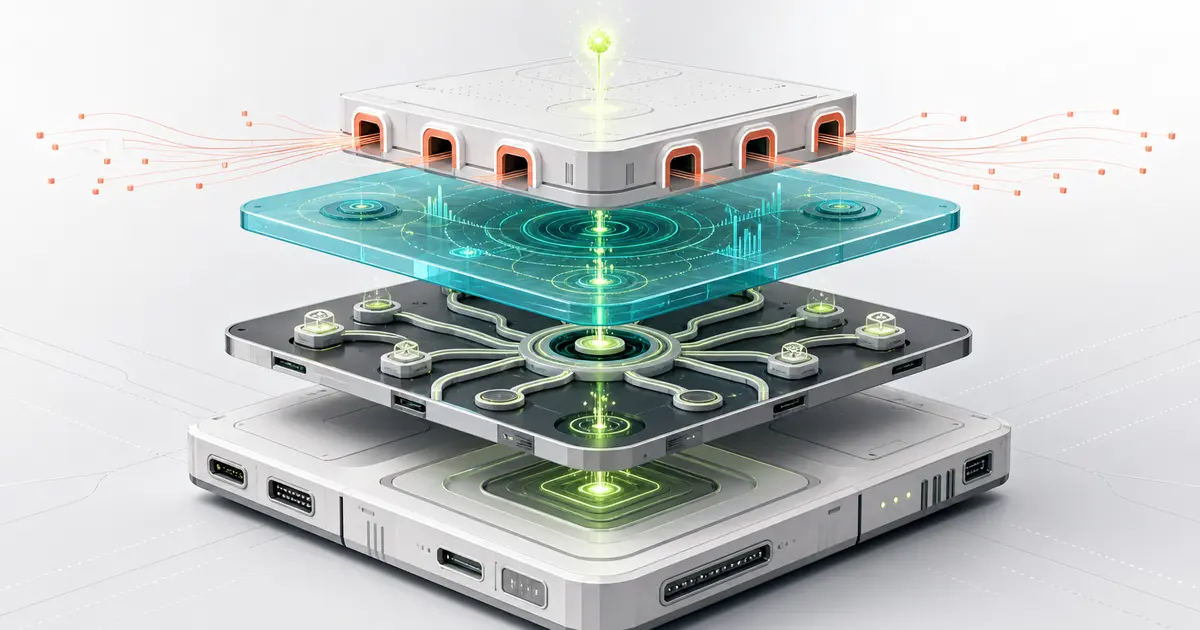
Agent-native infrastructure inverts the design center. Instead of optimizing for a human in the loop, it optimizes for an autonomous program that plans, calls tools, maintains state, and acts on a user's behalf. The shift is structural, and in 2026 it's becoming legible as a layered stack — much the way the cloud era resolved into compute, storage, networking, and observability layers. Four layers are now visible.
Which layers make up the agent-native stack?
The OS layer: an operating system built for agents, not apps
The most radical signal is at the bottom. Microsoft's Project Solara is, per Ars Technica, an Android-derived OS designed for agents instead of apps. That framing — "an OS for agents, not apps" — is a genuine paradigm shift, not a marketing line.
A traditional mobile OS assumes a human taps icons, grants permissions one screen at a time, and drives the interaction. An agent-first OS assumes the primary user is software: it needs programmatic access to capabilities, a permission model designed for delegated autonomous action, and a way to expose system functions as callable tools rather than tappable UI. When the OS itself treats the agent as the first-class citizen, everything above it can stop pretending a human is holding the phone.
Evaluate this layer by: how capabilities are exposed to agents, how the permission/trust model handles delegated authority, and whether the OS is open enough to build on without lock-in.
The runtime/orchestration layer: where agents actually run
One layer up is the runtime that plans and executes agent work. Microsoft's Scout, an autonomous AI agent, is built on the open OpenClaw stack — a detail corroborated in the Hacker News discussion. The significant part isn't that Microsoft shipped an agent; it's that a hyperscaler chose to build it on an open runtime rather than a fully proprietary one.
That choice matters for the whole stack. An open orchestration layer means the planning loop, tool-calling conventions, and execution model can be shared, inspected, and extended across vendors — the same dynamic that made open runtimes win in earlier platform shifts. This layer is where most builders will spend their time: it's the engine that turns a goal into a sequence of tool calls, handles retries and state, and decides when a task is done.
Evaluate this layer by: openness and extensibility, the quality of its tool-calling and state model, and whether you can run, inspect, and swap it rather than being locked to one vendor's loop.
The observability layer: you can't run in production what you can't see
Agents fail in ways traditional software doesn't: they hallucinate tool calls, loop, drift off-task, and make decisions that are hard to reproduce. That makes monitoring a first-class problem — and investors agree. Coralogix raised $200M to build the monitoring layer for AI agents, a clear signal that AI agent observability is becoming a funded category in its own right, not a feature of the runtime.
Monitoring agents means more than logging requests. It means tracing multi-step reasoning, capturing which tools were called and why, measuring task success rather than just uptime, controlling cost per task, and catching unsafe or off-policy behavior before it reaches a user. A dedicated observability tier is what makes autonomous agents operable at scale — the difference between a demo and a system you'll trust in production.
Evaluate this layer by: whether it traces full multi-step reasoning (not just API calls), how it measures task-level success and cost, and how it surfaces safety and policy violations.
The distribution layer: how agents reach users
The top of the stack is reach. Meta's AI agent for WhatsApp Business is now available globally, putting agents in front of small and medium businesses through a channel they already use every day. Distribution is the layer that decides whether an agent stays a lab demo or becomes something millions of people actually touch.
Agent-native distribution differs from app distribution: there's no icon to install or store listing to optimize. The agent meets users inside an existing conversational or workflow surface. That changes how you think about discovery, onboarding, and trust — the "interface" is a conversation, and the agent has to earn its place in a channel the user didn't choose specifically for AI.
Evaluate this layer by: which surfaces it reaches, how trust and permissions are handled at the point of contact, and how onboarding works without a traditional install step.
Why does framing this as a stack matter?
Because it changes how you make decisions. Treated as scattered news, Scout, Solara, Coralogix, and Meta's WhatsApp agent are just headlines. Treated as a stack, they become a checklist:
- Which OS / capability layer does your agent run on, and how does it get permissions?
- Which runtime orchestrates its reasoning — open or closed, swappable or locked-in?
- How will you observe it in production — task success, cost, and safety, not just uptime?
- Where will it actually reach users, and how does trust work on that surface?
Most teams today have a strong answer for the runtime and a weak answer for the other three. The 2026 signals say all four layers are now real, funded, and worth a deliberate choice. The era of treating agent infrastructure as "an API call plus some glue code" is ending.
Is the agent-native stack settled?
Not yet — and that's the opportunity. These are early, partly competing moves: one vendor's agent OS, one runtime, one well-funded observability bet, one distribution channel. The boundaries between layers will shift, and standards are still being fought over (the open-vs-proprietary tension visible in Scout's OpenClaw choice will play out across every layer). But the shape — OS, runtime, observability, distribution — is now clear enough to design against. Builders who organize their architecture around these layers will adapt faster than those still treating agents as ordinary apps.
Practical takeaways for builders and decision-makers
- Adopt the four-layer model as a planning tool. For any agent you ship, name your choice at each layer instead of defaulting to whatever your framework bundles.
- Don't skip observability. A funded category emerging around monitoring agents is your cue that production agents need task-level, safety-aware monitoring from day one — not after the first incident.
- Weigh openness deliberately. A hyperscaler building on an open runtime is a signal that lock-in at the runtime and OS layers is a real, long-term risk worth pricing in now.
- Match distribution to trust. Meeting users inside existing channels is powerful, but the agent has to earn permission to act — design for that.
The agent-native stack is no longer a forecast; its first real layers shipped this month. The teams that internalize the layering now will build agents that are operable, portable, and trusted — while everyone else keeps retrofitting an app-era stack to a job it was never designed for.
Building on the agent-native stack? Try Clawvard to design, run, and observe agents across these layers — and follow our updates as the agent infrastructure landscape keeps consolidating.
Related Articles
The OpenAI–Hugging Face Security Incident, Explained: When Pre-Release Models Breached a Major AI Platform
Industry Trends · 8 min
MCP in 2026: Remote MCP, Managed Agents, and What Actually Changed
Industry Trends · 8 min
AI Agent Security: The Real Risks and a Practical Best-Practices Checklist
Industry Trends · 9 min