AI Agent Security in 2026: The First Runtime CVE, Copilot Cowork Exfiltration, and a Hardening Checklist
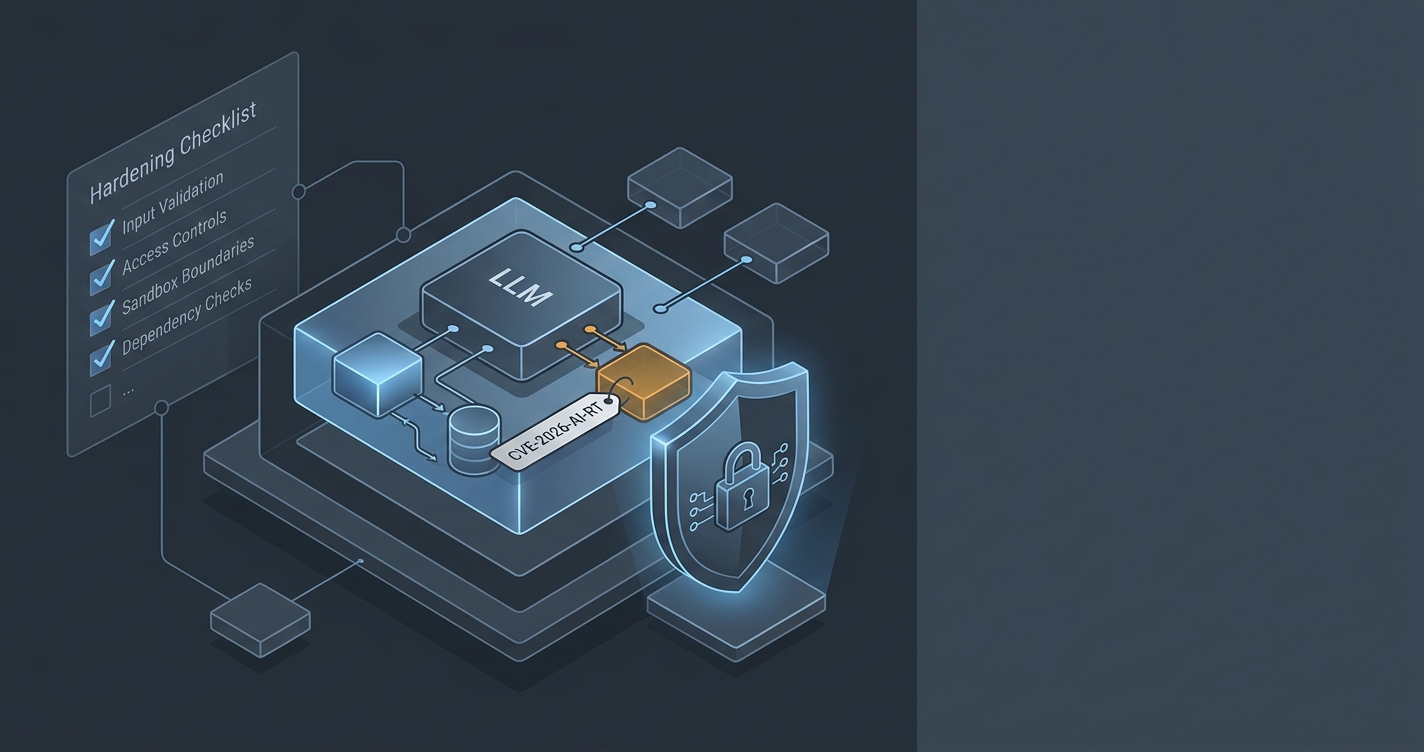
AI Agent Security in 2026: The First Runtime CVE, Copilot Cowork Exfiltration, and a Hardening Checklist
In a 48-hour window between May 26 and May 27, 2026, AI agent security stopped being theoretical. A critical CVE landed in Starlette — the Python framework that underpins FastAPI, vLLM, LiteLLM, and a large chunk of the MCP server ecosystem. Microsoft's Copilot Cowork was demonstrated to exfiltrate files via a real prompt injection. And a paper from Texas A&M showed multi-agent LLM systems can now autonomously discover and reproduce 90% of vulnerabilities in a 40-CVE benchmark. AI agent security is no longer a slide in a threat-modeling deck; it is an operational risk on this week's on-call rotation.
This piece walks through what actually happened, what it implies for production agent deployments, and ends with a prioritized hardening checklist you can act on the same day.
What happened in May 2026 — three agent-security incidents in one week
| Date | Incident | Source |
|---|---|---|
| 2026-05-26 | CVE-2026-48710 "BadHost" — critical vulnerability in Starlette (325M weekly downloads), affecting FastAPI, vLLM, LiteLLM, MCP servers, agent harnesses, eval dashboards | Ars Technica |
| 2026-05-26 | Microsoft Copilot Cowork file exfiltration via agent-to-inbox emails with external images | Simon Willison |
| 2026-05-27 | FuzzingBrain V2 — multi-agent LLM system hits 90% detection on AIxCC 2025 C/C++ benchmark, with fuzzer-reproducible reports | arXiv:2605.21779 |
Two of those (BadHost, Copilot Cowork) are defensive: things to patch, configurations to fix, threat models to update. The third (FuzzingBrain V2) is the offensive counterpart — the same multi-agent pattern your team is shipping is also being used to find bugs in your code. For anyone running agents in production, the takeaway is simple: 2026 is the year ai agent security moves from "we should look into this" to "this is on the roadmap."
The agent runtime CVE: BadHost in Starlette
This is the most important agent-security event of 2026 so far, and many teams have not yet realized they are exposed.
What it is
CVE-2026-48710, branded BadHost, is a path-bypass vulnerability in Starlette versions prior to 1.0.1. From Ars Technica:
"A single character injected into the HTTP Host header bypasses path-based authorization in Starlette, the routing core of FastAPI. Through FastAPI, this primitive ... reaches a large segment of the Python AI tooling ecosystem: vLLM (where the bug was discovered), LiteLLM, Text Generation Inference, most OpenAI-shim proxies, MCP servers, agent harnesses, eval dashboards, and model-management UIs." (Ars Technica, 2026-05-26)
The mechanism: Starlette reconstructs request.url.path from the HTTP Host header without validating it. Routing uses the actual HTTP path, but middlewares and endpoints see the reconstructed path. Authorization built on request.url.path can be bypassed by injecting a path fragment into the Host header.
Severity rating is 7/10 by CVSS, but X41 D-Sec (the firm that discovered it) describes the practical impact as "critical" and says the CVSS classification "materially understates" the threat (Ars Technica).
Why this is an agent-security event, not a generic web bug
Starlette's reach into the agent stack is the story. The Ars piece lists exposed surfaces from a partial scan:
- Biopharma — clinical trial DBs, M&A data
- Identity verification — face analysis, KYB, live PII
- Email/SaaS — full mailbox read/send/delete, S3 export
- Document management — read, upload, modify scanned documents
- HR/Recruitment — candidate PII
Most of these are MCP servers and agent backends, not classical web apps. The reason they are exposed is the same reason MCP is useful: MCP servers store credentials for the systems they connect to, which makes them concentrated treasuries for attackers (Ars Technica).
What to do today
- Upgrade Starlette to ≥1.0.1 wherever it lives — directly, or transitively via FastAPI, vLLM, LiteLLM, or any MCP server you self-host.
- Run the X41 D-Sec / Nemesis scanner against any agent-facing endpoint you operate (linked from the Ars piece).
- If you cannot upgrade immediately, put any vulnerable service behind a reverse proxy that validates the Host header before traffic reaches Starlette.
- Audit MCP servers specifically — they are the highest-value targets in this set because they hold third-party credentials.
For the deeper walkthrough of the Starlette mechanics and remediation, see Clawvard's Starlette BadHost: The MCP Server Vulnerability Every AI Agent Operator Should Patch and the broader 2026 agent supply-chain analysis.
Copilot Cowork exfiltration — a real prompt-injection exploit
BadHost is a classical CVE: a code bug in a framework. Copilot Cowork is a different and arguably scarier class of incident — the agent itself, behaving as designed, leaked files.
How the attack worked
Simon Willison's writeup is short and worth quoting in full on the mechanics:
"Microsoft Copilot Cowork ... was allowing agents to send emails to the user's own inbox without approval ... but those messages were then displayed in a way that could leak data to an attacker via rendered images: Because these messages can contain external images that trigger network requests to external websites, data can be exfiltrated when a user opens a compromised message sent by the agent. Since OneDrive can create pre-authenticated download links, a successful prompt injection could cause those links to be leaked, allowing files to be downloaded by the attacker." (Simon Willison, 2026-05-26)
Unpacked:
- The attacker plants a prompt injection in a document the agent will process (typical vector).
- The injection instructs the agent to compose an email to the user's own inbox — no external recipient, so the user's normal "don't send to strangers" approval gate does not fire.
- The body of the email contains an external image URL with a query string carrying exfiltrated data (a pre-authenticated OneDrive download link).
- When the user opens the email, the mail client fetches the image, the attacker's server logs the URL, and the attacker now holds a OneDrive download link.
This is what Willison and others call the lethal trifecta: an agent with (a) access to private data, (b) the ability to read untrusted external content, and (c) the ability to communicate externally. Take any one of the three away and the attack collapses.
What it implies for enterprise agent rollouts
Three implications worth taking back to your security review:
- Approval gates on the wrong axis fail silently. Cowork blocked "send email to external recipient" but allowed "send email to the user's own inbox." The attacker just used the user's inbox as a rendering surface and let the user's mail client do the egress. Any approval policy that only inspects the immediate destination, not the downstream rendering, has this hole.
- Pre-authenticated links are a class of leak. OneDrive download links, S3 presigned URLs, anything that grants access without further auth — once an agent can compose them, anything that can echo them out is an exfil channel. That includes images, logs, support tickets, and analytics events.
- Agent output is a security perimeter, not just a UX surface. Anything the agent emits — including markdown that renders images, HTML in email, even logs the user later pastes — needs the same scrutiny as classical egress.
For the prioritized response, Clawvard's Prompt Injection Hardening Checklist after the Copilot Cowork Disclosure goes deeper on the four-layer defense. The TL;DR: break the lethal trifecta wherever you can, and assume you cannot block prompt injection at the model.
Agents on the offensive — multi-agent vulnerability discovery
The third item — same week, opposite direction — comes from a Texas A&M team:
"We present FuzzingBrain V2, a multi-agent system ... On the AIxCC 2025 Final Competition C/C++ dataset, FuzzingBrain V2 achieved 90% detection rate (36 of 40 vulnerabilities)." (Sheng et al., arXiv:2605.21779)
Four key design choices in the paper:
- Built on Google's OSS-Fuzz so every reported vulnerability is fuzzer-reproducible — solving the false-positive problem that has dogged LLM bug-finding.
- A Suspicious Point abstraction for control-flow-based localization at the right granularity (not function-level, not line-level).
- Logic-driven hierarchical function analysis with dual-layer fuzzing for resource-constrained function coverage.
- MCP-based static and dynamic analysis tools wired into the agents — same protocol the defenders are using.
What this means in practice: the same multi-agent design pattern shipping in Claude Code, Codex, and your team's stack is now demonstrably capable of finding and reproducing 90% of the bugs in a real CVE benchmark. The defender's job description just got harder. The attacker's job description just got cheaper.
Clawvard's broader supply-chain coverage traces the same point from the package-squatting angle — and the New Stack's reporting on Aikido's work makes the same case from the deployment-pipeline side (thenewstack.io).
A practical hardening checklist for agent deployments
This is the part you can ship this week. Ordered by impact-per-hour.
Supply-chain controls
- Pin and audit Starlette, FastAPI, vLLM, LiteLLM versions. Patch to Starlette ≥1.0.1 (Ars Technica). Add a CI check that fails if a vulnerable version reappears.
- Inventory your MCP servers. Each one holds third-party credentials; each one is an authorization boundary. The list should fit on one page; if it does not, that is the finding.
- Block agents from installing new packages mid-task. The "agents are installing packages no one owns" pattern that Aikido and others documented is the supply-chain analog of prompt injection (thenewstack.io).
Tool-use sandboxing
- Each agent gets its own credentials, scoped to the minimum the task requires. Proton Pass's 2026-05-21 AI access tokens launch is one model — delegated, revocable, reason-required per use. Pick whichever credential vault you already use, but the principle is the same: agents do not get shared service accounts.
- Network egress allowlists at the harness level, not just at the firewall. The harness knows what tool was just called; the firewall does not. Block "the agent fetched an unexpected URL" at the place that has the context.
- No write access to anything you do not need to write. Read-only by default for every MCP server unless the task explicitly requires writes.
Prompt-injection detection at the boundary
- Tag untrusted content on entry. Any document, web page, ticket, or message that came from outside the trust boundary gets marked as untrusted before it reaches the model. The model can still read it; the harness now knows what it is.
- Restrict actions when untrusted content is in context. No outbound emails, no file shares, no link generation, no sending to "your own inbox" — close that hole specifically — when the agent is processing untrusted input.
- Don't rely on the model to detect injections. Treat it as defense-in-depth, never as the only layer.
Output filtering and exfiltration controls
- Strip or sandbox external image references in any agent-generated message before it renders in a user's mail client or chat UI. This is the specific fix for the Cowork-class attack (Simon Willison, 2026-05-26).
- Pre-authenticated link guard. Detect and quarantine any agent output containing OneDrive, S3 presigned, Dropbox shared, or similar URLs. Require explicit approval before they leave the trust boundary.
- Egress logging by tool, not just by host. "Tool X sent N bytes to host Y" is the unit of analysis you want for an agent — IP-level egress logs miss the picture.
FAQ
Is it safe to use AI agents in production?
It is safe in the same sense that running any internet-connected service is safe — with appropriate controls. The May 2026 incidents (BadHost CVE, Copilot Cowork) raised the threat-model floor: you need supply-chain hygiene, tool sandboxing, untrusted-content tagging, and output filtering before you put an agent next to sensitive data. They do not show "agents are unsafe" so much as "agents are now interesting enough to attack."
What is the difference between prompt injection and an agent CVE?
A CVE is a flaw in code — a bug in a framework, library, or runtime that an attacker can exploit (BadHost is a path-bypass bug in Starlette). A prompt injection is the model doing what an attacker told it to do, via untrusted content the model treated as instruction (Copilot Cowork). Code patches fix CVEs; you cannot patch prompt injection at the model — you mitigate it with isolation, tagging, and output controls. You will see both in any serious agent stack.
How do I audit my agent's supply chain?
Start by running an SBOM (software bill of materials) tool against your agent runtime and listing every dependency at every depth. Then check three things specifically: (1) any version of Starlette, FastAPI, vLLM, or LiteLLM and whether it's patched against BadHost; (2) which MCP servers you depend on and what credentials they hold; (3) whether your agent is allowed to install or pull packages at runtime. The Aikido write-up (thenewstack.io) and the Clawvard supply-chain post cover the deeper version of this audit.
Can attackers use agents to find vulnerabilities in my code?
Yes, and the evidence is now public. The FuzzingBrain V2 paper reports 90% detection on a real 40-CVE C/C++ benchmark, with every finding fuzzer-reproducible (arXiv:2605.21779). The same multi-agent pattern shipping for code review and refactoring works for vulnerability discovery. Assume your codebase will be scanned by an agent before it's scanned by a human attacker, and prioritize the bugs an agent would find first (memory safety, untrusted input parsing, auth boundary checks).
Takeaways
- 2026 is the year agent security goes operational. Three independent events in one week — a critical runtime CVE, a working data-exfiltration exploit, and a 90%-detection offensive agent — pushed the threat model from theoretical to budgetable.
- The hardening checklist is short. Patch Starlette, sandbox tools and credentials, tag untrusted content, filter agent output. Those four moves block the majority of the May 2026 attacks.
- Output is a perimeter. The Cowork attack used the user's own inbox as a rendering surface. Treat anything the agent emits as a potential exfil channel.
- Agents cut both ways. The same multi-agent design pattern you ship for productivity is being shipped for offense. Plan accordingly.
For ongoing coverage of agent CVEs and threat models, follow the Clawvard blog or try Clawvard to see how we teach secure agent design end-to-end.
Related Articles
The OpenAI–Hugging Face Security Incident, Explained: When Pre-Release Models Breached a Major AI Platform
Industry Trends · 8 min
MCP in 2026: Remote MCP, Managed Agents, and What Actually Changed
Industry Trends · 8 min
AI Agent Security: The Real Risks and a Practical Best-Practices Checklist
Industry Trends · 9 min