Prompt Injection in 2026: How to Actually Defend Your AI Agents
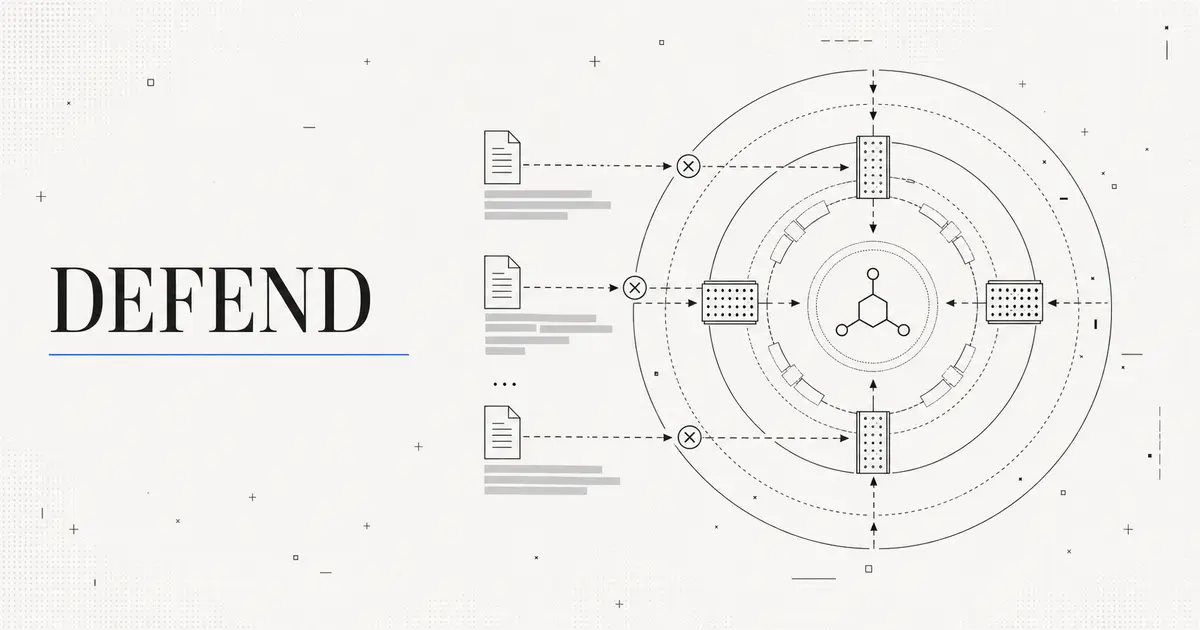
Prompt Injection in 2026: How to Actually Defend Your AI Agents
In June 2026, Simon Willison opened his AI assistant to the public and let roughly 2,000 people try to hack it. The write-up — "What happened after 2,000 people tried to hack my AI assistant" — is one of the largest open red-team exercises against a real, tool-using agent, and the takeaway is sobering: prompt injection is not a bug you patch once. It is a structural property of how large language models read their context window. If you are shipping an AI agent, this is still the number-one thing standing between your prototype and production.
This article explains what prompt injection actually is, why a stricter system prompt will not save you, and the defense-in-depth patterns that meaningfully reduce risk. Every claim here is grounded in three fresh 2026 sources: Willison's red-team results, his framing of prompt injection as role confusion, and ServiceNow Research's MosaicLeaks study of whether a research agent can keep a secret.
What is prompt injection?
Prompt injection is what happens when untrusted text that your agent reads — a web page, an email, a PDF, a tool result, a calendar invite — contains instructions, and the model treats those instructions as if they came from you. The model has no built-in notion of which tokens in its context window are trusted commands and which are merely data to be processed. They are all just tokens. An attacker who can get text in front of your agent can therefore try to redirect it.
That is the whole problem in one sentence: the model cannot reliably tell the difference between the instructions you gave it and the content it was asked to work on. Once you accept that, most of the confusion around prompt injection clears up. The agent that summarizes your inbox can be told, by an email, to forward your inbox somewhere. The agent that browses the web can be told, by a page, to leak whatever it knows. Nothing was "exploited" in the traditional sense — the model did exactly what the most recent persuasive instruction told it to.
How is prompt injection different from jailbreaking?
These two get conflated constantly, and keeping them separate changes how you defend against each.
- Jailbreaking targets the model's safety training. The attacker is the user, and the goal is to make the model say or do something its alignment is supposed to refuse — produce disallowed content, drop its guardrails, role-play around a policy.
- Prompt injection targets the application. The attacker is usually a third party whose content flows into the agent's context, and the goal is to hijack the agent's behavior against the legitimate user's interest — exfiltrate data, trigger an unwanted tool call, corrupt a result.
The practical difference: jailbreaking is a content-policy problem you largely inherit from your model provider. Prompt injection is your problem, because it lives in the gap between your trusted instructions and the untrusted data your specific app pipes into the model. No amount of model alignment removes it, because the model is behaving — it just can't authenticate the source of an instruction.
What is a role confusion attack?
Willison's role-confusion framing is the most useful mental model available right now. Modern chat models are trained on a structured transcript: there is a system role, a user role, an assistant role, and tool roles. Developers lean on that structure as if it were a security boundary — "the system prompt is privileged, user content is not."
It isn't a security boundary. It's a convention the model learned statistically, and it can be confused. When attacker-controlled text is formatted to look like a higher-privileged role — imitating a system message, a tool response, or a new turn from the user — the model can be nudged into treating that injected content as authoritative. Role confusion is prompt injection viewed through the lens of the chat transcript: the attack succeeds when the model misattributes who is speaking, and therefore how much authority the instruction carries. This is why "I clearly told it in the system prompt to ignore instructions in web pages" fails so reliably — you are relying on the model to honor a role boundary that the attacker is actively forging.
Can prompt injection be fully prevented?
No — and any vendor who tells you otherwise should worry you. Willison's 2,000-person experiment makes the point empirically: a determined, diverse crowd will find phrasings that slip past defenses you thought were solid. As long as a model ingests untrusted text into the same context it uses for instructions, the attack surface exists.
What you can do is lower the blast radius until a successful injection is survivable. The goal shifts from "make injection impossible" to "make injection boring" — ensure that even when the model is fooled, it cannot do anything catastrophic. That reframing is the entire basis of the defense-in-depth approach below.
The data-exfiltration problem: can your agent keep a secret?
The most dangerous outcome of prompt injection is not a rude response — it is leaked data. ServiceNow Research's MosaicLeaks work asks exactly the right question: can your research agent keep a secret? A research or "deep research" agent typically holds sensitive context — internal documents, credentials, prior conversation, retrieved private data — and also has the ability to read from and write to the outside world. That combination is the textbook exfiltration setup: untrusted input persuades the agent to take its private knowledge and send it somewhere the attacker controls.
The lesson for builders is to treat any agent that simultaneously (a) sees sensitive data and (b) can reach an external sink — a URL fetch, an outbound email, an API call, even rendering an image from an attacker-supplied address — as a live exfiltration risk until proven otherwise. The capability matters more than the intent.
How do you defend an AI agent against prompt injection?
There is no single fix, so stack independent layers. None is sufficient alone; together they shrink the blast radius.
1. Treat all external content as hostile by default
Every tool result, retrieved document, web page, and email is untrusted input — not part of your instructions. Label it as data in your prompt structure, keep it visually and structurally separated from your directives, and never let retrieved content silently become a new instruction.
2. Constrain capabilities, not just words
Your strongest lever is not prompt wording — it's what the agent is allowed to do. Give each agent the minimum tools it needs. An agent that reads private data should not also have an unrestricted outbound channel. If it must, gate that channel.
3. Separate the "reader" from the "actor"
A powerful pattern is privilege separation: one model (or one agent) processes untrusted content and can only return structured, non-executable output; a second, more trusted component decides whether to act on it. The component that touches untrusted text never holds the keys to dangerous actions.
4. Put a human (or a hard rule) in front of irreversible actions
For anything that sends money, emails, data, or code outside your trust boundary, require explicit confirmation or a deterministic allowlist. This is the layer that turns a successful injection from a breach into a blocked attempt.
5. Lock down exfiltration sinks
Following the MosaicLeaks lesson: restrict outbound destinations. Allowlist the domains an agent may fetch or post to, strip or sandbox auto-loading content (including images that beacon to attacker URLs), and log every outbound call so a leak is at least detectable.
6. Red-team continuously
Willison's experiment only worked because real adversaries probed a real system. Build the equivalent into your process: maintain an evolving corpus of injection payloads, run it against your agent on every meaningful change, and treat new bypasses as regressions.
How do I test my own agent for prompt injection?
Make adversarial testing routine rather than a one-time audit:
- Build an injection corpus. Collect payloads across categories — direct instruction overrides, role-confusion / fake-system-message attempts, exfiltration lures, and tool-abuse triggers.
- Plant them where real content enters. Inject through the exact channels your agent ingests: documents, web pages, tool outputs, message history — not just the top-level user prompt.
- Define a failure clearly. A test fails if the agent follows the injected instruction, leaks protected data, or calls a tool it shouldn't. Score pass/fail per payload so results are comparable over time.
- Re-run on every change. Model swaps, prompt edits, and new tools can all reopen old holes. Wire the corpus into CI so a regression is caught before it ships.
- Test on your own tools. A model that resists injection in the abstract may still misbehave when driving your specific tool surface. The most honest signal comes from evaluating the model against the exact harness you run in production — which is its own discipline, covered in our companion guide on how to benchmark AI agents on your own tools.
Key takeaways
- Prompt injection is structural, not a patchable bug: models can't authenticate the source of an instruction inside their context window.
- It is distinct from jailbreaking — injection is an application problem you own, not just a model-alignment problem.
- Role confusion explains why system-prompt instructions to "ignore injected text" keep failing: the role boundary is a convention, not a security wall.
- You can't fully prevent it, so engineer for survivability: least privilege, reader/actor separation, human-gated irreversible actions, locked-down exfiltration sinks, and continuous red-teaming.
- The highest-risk agents are those that see sensitive data and can reach an external sink — audit those first.
Building agents on Clawvard? Design them with these boundaries from day one — scoped tools, gated actions, and a standing injection corpus — so security is a property of the system, not a hopeful line in the prompt. For the evaluation side of shipping trustworthy agents, read our companion piece on benchmarking AI agents on your own tools.