AI Agent Security: The Real Risks and a Practical Best-Practices Checklist
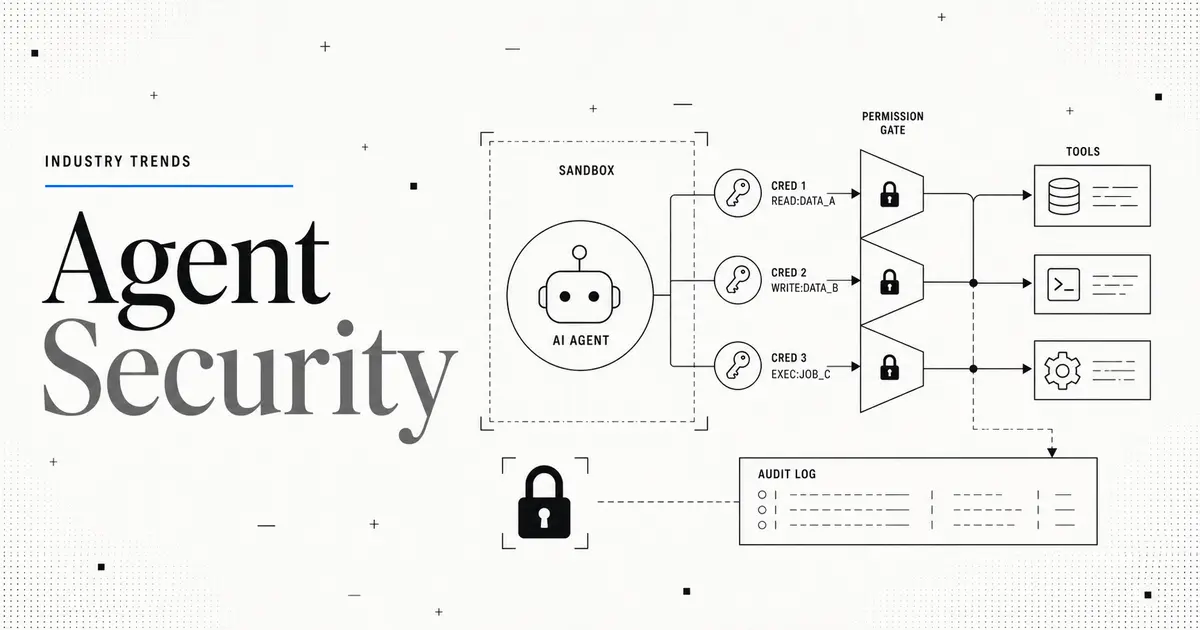
AI Agent Security: The Real Risks and a Practical Best-Practices Checklist
AI agent security has become the defining production problem of the agentic era, and the numbers explain why. In a recent enterprise survey reported by VentureBeat, 54% of organizations said they had already experienced an AI agent security incident — and most still let their agents share credentials. That is the gap in a sentence: agents are already in production, already touching real systems, and the controls around them have not caught up. If you are shipping agents that can call tools, move money, write to databases, or send messages on a user's behalf, the threat model is no longer theoretical.
This article lays out what actually goes wrong with AI agents, why traditional application security assumptions break down when an autonomous model is in the loop, and a concrete best-practices checklist you can apply before your next agent reaches production.
What are the biggest AI agent security risks?
An AI agent is not just a chatbot that answers questions — it is a system that reads inputs, decides on actions, and executes them through tools. That action-taking capability is exactly what expands the attack surface. The biggest risks cluster into a few categories:
- Over-privileged and shared credentials. The single most striking finding from the VentureBeat survey is that most organizations still let agents share credentials. When one agent identity holds broad, long-lived access to many systems, a single compromised or manipulated agent becomes a skeleton key. There is no per-action accountability and no blast-radius containment.
- Prompt injection and tool manipulation. Because agents act on natural-language instructions — including instructions embedded in the data they read (web pages, emails, documents, API responses) — an attacker can smuggle commands into that data. A malicious instruction hidden in a retrieved document can redirect the agent to exfiltrate secrets, call the wrong tool, or take an action the user never asked for.
- Excessive autonomy without guardrails. Agents that can chain many steps without checkpoints can compound a small error into a large one. A wrong tool call early in a plan can cascade, and without approval gates on high-impact actions, there is nothing to stop it.
- Weak observability. Many teams cannot answer basic forensic questions after an incident: which agent did what, with which credentials, in response to which input. Without an audit trail, you cannot detect, investigate, or contain agent misbehavior.
The through-line is that agents inherit the trust we give them but not the judgment we assume they have. Security has to be designed around that.
Should AI agents share credentials?
No. Shared credentials are the highest-leverage risk to fix, and it is the one the data says most teams are getting wrong. Each agent — and ideally each agent task — should operate under its own scoped, least-privilege identity, with permissions narrowed to exactly the tools and data that specific job requires.
Practically, that means:
- Issue distinct, short-lived credentials per agent rather than a shared service account.
- Scope each credential to the minimum set of actions the agent needs (read-only where possible, no standing write/delete access to systems the task does not touch).
- Rotate and expire credentials aggressively, so a leaked token has a short useful life.
- Never let an agent hold a "god" credential that can reach every system just because it is convenient.
Least-privilege is not glamorous, but it is the control that most directly shrinks the blast radius when — not if — something goes wrong.
How do you red-team an AI agent?
Red-teaming is the practice of attacking your own system before someone else does, and the frontier labs are now industrializing it. In July 2026, OpenAI introduced GPT-Red, an LLM it describes as a "super-hacker" built to make its own models safer, a project covered in depth by MIT Technology Review. The idea is to use a capable model to continuously probe for weaknesses and feed those findings back into hardening — turning red-teaming into a self-improvement loop rather than a one-time audit.
You do not need a frontier lab's resources to apply the same principle to your own agents:
- Simulate prompt injection. Feed your agent adversarial documents, web pages, and tool responses that contain hidden instructions, and verify the agent does not obey them.
- Test privilege boundaries. Try to get the agent to reach systems or take actions outside its intended scope. If it can, your permissions are too broad.
- Probe the tool layer. Confirm that every tool the agent can call validates its inputs and cannot be coerced into destructive or out-of-scope operations.
- Make it continuous. Attacks and model behavior both drift, so red-teaming should run on a schedule, not once at launch.
The takeaway from GPT-Red is directional: treat adversarial testing as an ongoing part of the agent lifecycle, not a checkbox.
What is an AI agent security checklist?
Here is a practical checklist you can adapt for any agent heading to production. It maps the risks above to concrete controls.
Identity and access
- Every agent runs under its own scoped identity — no shared credentials.
- Permissions follow least-privilege; write/delete access is granted only where the task requires it.
- Credentials are short-lived and rotated automatically.
Input and prompt-injection defense
- Untrusted content (retrieved documents, web pages, tool outputs) is treated as data, not commands.
- The agent is tested against prompt-injection payloads before launch and on a recurring basis.
- High-risk instructions trigger validation or human approval rather than silent execution.
Tool and action safety
- Each tool validates its own inputs and enforces its own authorization.
- High-impact actions (payments, deletions, external messages) sit behind approval gates or dry-run confirmation.
- Agents operate in sandboxed environments where feasible, limiting what a compromised step can reach.
Observability and response
- Every agent action is logged with the identity, input, tool call, and outcome.
- You can reconstruct exactly what an agent did after the fact.
- Anomalous agent behavior triggers alerts, and there is a defined containment plan.
The market is already forming around this need. On the builder side, new entrants like Traceforce, launched on Hacker News as company-wide security monitoring for AI apps, signal that agent-specific security tooling is becoming its own category — corroborating that this is a real, present problem rather than a future one.
Why AI agent security is different from traditional app security
Classic application security assumes deterministic behavior: given the same input, the code does the same thing. Agents break that assumption. They make probabilistic decisions, they act on natural language, and they treat data as potentially instructional. That means:
- The input is the attack surface. Data an agent reads can carry commands, so you cannot cleanly separate "content" from "control."
- Authorization has to move to the action layer. You cannot rely on the model to police itself; the tools and systems it calls must enforce their own boundaries.
- Testing must be adversarial and continuous. Static analysis of code is not enough when behavior emerges at runtime from a model's decisions.
Designing for these differences up front is far cheaper than retrofitting controls after an incident.
Key takeaways
- AI agent security is a production reality, not a hypothetical: a majority of surveyed enterprises have already had an incident, and shared credentials remain widespread.
- Fix identity first — scoped, least-privilege, short-lived credentials per agent shrink the blast radius more than any other single control.
- Treat everything an agent reads as a potential attack vector, and enforce authorization at the tool layer, not in the model's "judgment."
- Red-team continuously; the direction OpenAI signaled with GPT-Red — adversarial testing as a self-improving loop — applies at any scale.
- Instrument for forensics before you need them: no audit trail means no detection, investigation, or containment.
Shipping agents responsibly has two halves. Securing them is one; the other is knowing they actually work as intended. For the evaluation side of that equation — how to tell a real agent from a wrapped chatbot and how to measure agent performance before production — read our companion guide, How to Evaluate AI Agents.
Ready to build and run agents on infrastructure designed with these controls in mind? Explore what you can build with Clawvard.
Related Articles
The OpenAI–Hugging Face Security Incident, Explained: When Pre-Release Models Breached a Major AI Platform
Industry Trends · 8 min
MCP in 2026: Remote MCP, Managed Agents, and What Actually Changed
Industry Trends · 8 min
The Three Gaps Killing Enterprise AI Agents in Production: Security, Evaluation, and Context
Industry Trends · 8 min