AI Trading Agents Explained: How Autonomous Agents Trade Your Money (and What Can Go Wrong)
AI Trading Agents Explained: How Autonomous Agents Trade Your Money (and What Can Go Wrong)
For years, "AI in investing" meant a robo-advisor quietly rebalancing an index portfolio, or a quant fund running code no retail investor would ever see. That line is now blurring. Mainstream brokerages are beginning to ship AI trading agents to ordinary users — autonomous software that can take in market data, form a view, and place trades on your behalf. In late May 2026, TechCrunch reported that Robinhood now lets AI agents trade stocks, the first time a major consumer brokerage has exposed a trading surface to autonomous agents. The Hacker News discussion that followed (85 points, 159 comments) was considerably more skeptical than the announcement — and that tension is exactly what makes this worth explaining rather than recapping.
This is a durable how-it-works guide: what an AI trading agent actually is, how the decision loop works, what can go wrong, and how to think about the risks — whether you're a retail investor deciding whether to flip the feature on or a builder shipping one.
What is an AI trading agent?
An AI trading agent is autonomous software that can decide and act in markets on your behalf — pulling data, forming a trade thesis, and executing orders within whatever permissions you grant it. The word that matters is autonomous: it closes the loop from analysis to action with limited or no per-trade human approval.
It helps to place it against two things people already know:
- vs. a robo-advisor: A robo-advisor allocates and rebalances a portfolio according to a fixed, pre-set strategy (your risk profile maps to a target mix). It is rules-based and slow-moving. A trading agent reasons over current conditions and can take discretionary, timing-based actions a robo-advisor never would.
- vs. an algorithmic trading bot: Classic algo trading also automates execution, but it follows deterministic, hand-written rules ("if the 50-day crosses the 200-day, buy"). An AI agent instead uses a language/decision model to interpret messier inputs — news, filings, sentiment — and generate actions that weren't explicitly coded. That flexibility is the selling point and the source of new risks.
For the broader pattern of agents that take consequential real-world actions with money, see our explainer on agentic payments.
How does an AI trading agent actually work?
Under the hood, most trading agents run a four-stage loop:
- Data. The agent ingests inputs — prices, fundamentals, news, filings, possibly social sentiment. The quality and trustworthiness of these feeds largely determines everything downstream.
- Signal. A model interprets the data into a view: an opportunity, a risk, a directional bias. In an AI agent this step is probabilistic reasoning, not a fixed formula — which is why two runs can disagree.
- Decision. The agent turns a signal into a concrete plan: what to trade, how much, and within what risk limits. Well-designed agents constrain this stage with position sizing and guardrails.
- Execution. The agent places the order through the brokerage's API and then loops back to monitor and adjust.
The leap from older systems is at the signal and decision stages: an algo bot's logic is auditable line by line, while an agent's reasoning is emergent and can change with the inputs. That's what lets it handle ambiguity — and what makes its behavior harder to predict.
What can go wrong with AI trading agents?
This is where the evergreen value lives, because the failure modes outlast any single product launch:
- Hallucinated signals. A language model can produce confident, well-worded reasoning for a trade based on a misread or fabricated "fact." Confident prose is not a correct thesis.
- Prompt injection on market data. If the agent reads news, filings, or social posts, an attacker can craft content designed to manipulate the agent's decision — the trading-specific face of the agent-security problems we cover in our prompt injection hardening checklist. An agent with brokerage access is an unusually high-value target.
- Over-trading. An always-on agent can churn the account — racking up costs and taxable events — chasing marginal signals a human would ignore.
- Cascading errors. Autonomous loops can compound: one bad decision feeds the next input, and a small error becomes a fast, large one before anyone notices.
- The accountability gap. When an autonomous agent loses money, who is responsible — the user who enabled it, the brokerage that shipped it, or the model vendor? This is unsettled, and it's the question retail investors most often skip.
Are AI trading agents safe for retail investors?
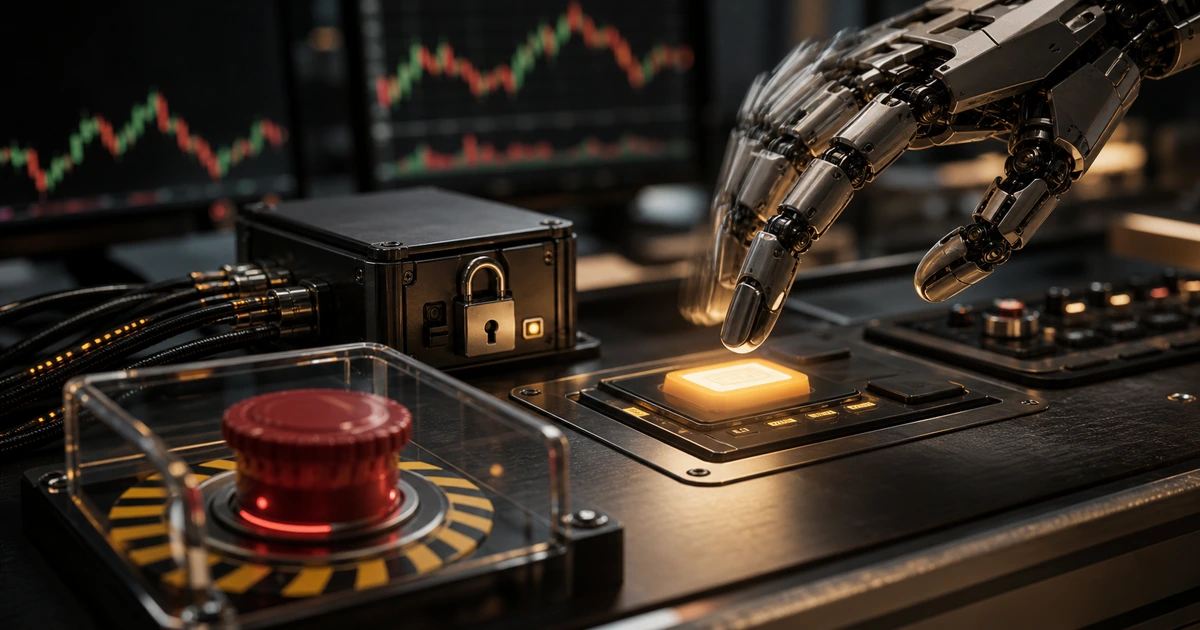
Honestly: it depends on the leash, not the label. The relevant questions aren't "is the AI good?" but "how much can it do without me, and what stops it when it's wrong?" Before enabling one, a retail investor should know: what hard limits cap position size and total exposure; whether trades require approval or execute autonomously; whether there's a kill switch; and who is liable when it loses money. An agent with tight caps, human approval on large trades, and a clear off switch is a very different risk than one with discretionary control of your full balance. The same principle that governs any agent with financial authority applies here: never grant an agent more power over money than you can afford to have it misuse — the core lesson of our agentic payments explainer.
How is this different from the algorithmic trading we already had?
Three differences matter. Inputs: algo trading runs on structured signals; AI agents ingest unstructured, manipulable inputs like news and sentiment. Logic: algo rules are deterministic and auditable; agent reasoning is probabilistic and emergent. Autonomy: classic systems execute a human-designed strategy, whereas an agent can choose strategies and adapt — which means it can also surprise you. In short, we've traded auditability for flexibility, and that trade is the whole story. Because an agent's inputs and tools are now an attack surface, the broader AI agent security guide for 2026 applies directly to anything that can move your money.
Frequently asked questions
Can AI trading agents lose my money?
Yes. Like any trading strategy they can lose money, and the autonomy adds failure modes a human trader wouldn't have — hallucinated signals, over-trading, and cascading errors. Caps, approval gates, and a kill switch reduce but do not eliminate the risk.
Are AI trading agents regulated?
The activity sits under existing securities and brokerage rules, but accountability for an autonomous agent's specific decisions is still unsettled. Treat "who is liable when it's wrong?" as an open question and read your brokerage's terms before enabling one.
Should I let an agent trade for me?
Only with limits you set and understand: hard position/exposure caps, approval on large trades, and a clear off switch. Match the authority you grant to the amount you can afford to have misused — and start far smaller than you think.
Takeaways for investors and builders
AI trading agents are real and arriving on consumer platforms, but the headline ("AI now trades for you") hides the only thing that matters: how much autonomy you grant and what stops the agent when it's wrong. For investors, that means caps, approval gates, a kill switch, and clear-eyed expectations about hallucinated signals and the accountability gap. For builders, it means hardening the data and signal stages against manipulation, constraining the decision stage with real risk limits, and never shipping unbounded autonomy over someone's money.
To go deeper, read our agentic payments explainer, and — because market data and tool access are attack surfaces — the AI agent security guide for 2026 and our prompt injection hardening checklist.
Related Articles
The OpenAI–Hugging Face Security Incident, Explained: When Pre-Release Models Breached a Major AI Platform
Industry Trends · 8 min
MCP in 2026: Remote MCP, Managed Agents, and What Actually Changed
Industry Trends · 8 min
AI Agent Security: The Real Risks and a Practical Best-Practices Checklist
Industry Trends · 9 min