Apache Burr vs LangGraph: Building Reliable AI Agents That Don't Fall Over
Apache Burr vs LangGraph: Building Reliable AI Agents That Don't Fall Over
If you have shipped an AI agent to production, you already know the failure mode: it works beautifully in the demo, then drifts, loops, or silently breaks the moment real users hit it — and you have no idea which step went wrong. That reliability gap is exactly why Apache Burr landed on the Hacker News front page in June 2026 (246 points and 115 comments), and why engineers keep asking how it stacks up against LangGraph. Both frameworks promise structured, debuggable agents. This guide explains what Burr actually is, how its state-machine model differs from LangGraph's graph approach, when to reach for each, and how to stand up a reliable agent quickly.
What is Apache Burr?
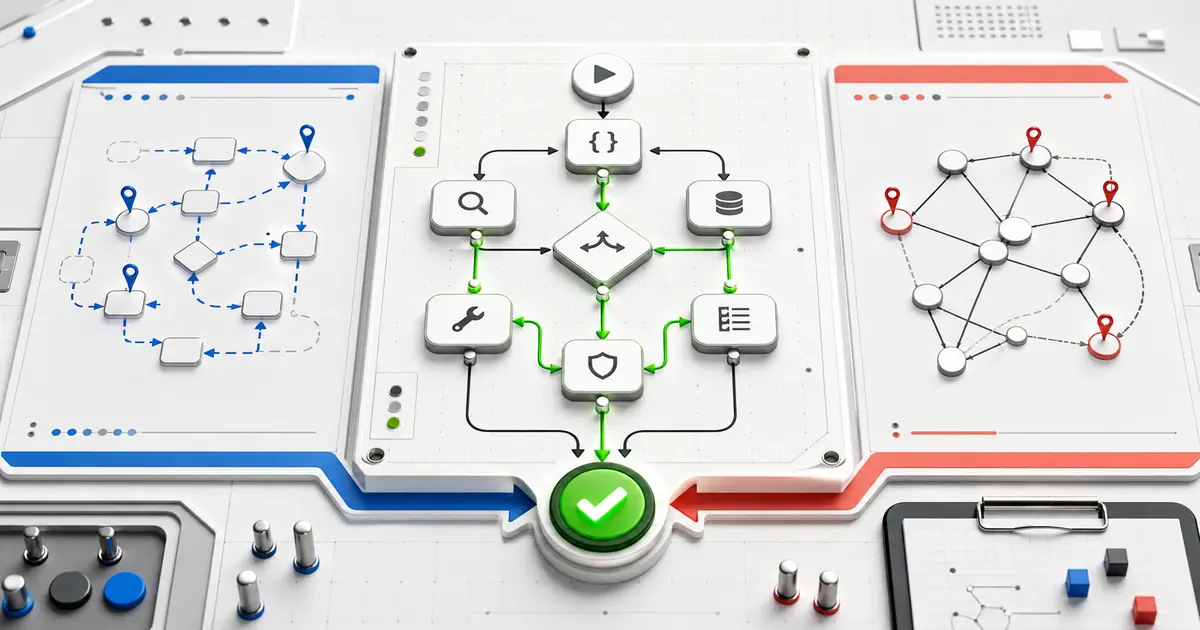
Apache Burr is a framework for building AI agents and applications as state machines. Instead of expressing your agent as free-floating function calls glued together with control-flow, Burr asks you to model it explicitly: a set of actions (the steps your agent can take) and transitions (the rules for moving between them), all operating over a single, inspectable state object. You can read more on the Apache Burr project site.
The payoff is observability. Because every step reads from and writes to explicit state, and every transition is declared, the framework can show you exactly where execution is at any moment, what the state looked like, and why it moved where it did. For agents — which are notoriously hard to debug precisely because their control flow is dynamic — that visibility is the whole point.
How does Burr's state-machine model work?
The mental model is small enough to hold in your head:
- State is a single structured object that carries everything the agent knows — conversation history, intermediate results, flags, counters.
- Actions are the units of work. Each action takes the current state, does something (calls an LLM, hits a tool, runs logic), and returns an updated state.
- Transitions declare how the application moves from one action to the next, often conditionally based on what is now in state.
Because the flow is declared rather than buried in imperative code, the entire agent becomes a graph of named steps you can visualize, log, replay, and reason about. When something goes wrong in production, you are not staring at a stack trace inside a nested chain — you are looking at a state machine that tells you it was in action generate_answer, with this state, and took this transition.
Apache Burr vs LangGraph — what's actually different?
Both frameworks model agents as graphs of steps over shared state, so the honest answer is that they overlap more than the "vs" framing suggests. The differences are ones of emphasis and lineage:
- Framing and vocabulary. Burr's primitives are actions and transitions over a state machine — the state-machine metaphor is front and center. LangGraph models your agent as a graph of nodes and edges, with state threaded through, and leans on the same graph metaphor it shares with the broader LangChain ecosystem.
- Ecosystem gravity. LangGraph sits inside the LangChain world, which means a large surface of off-the-shelf integrations, tools, and patterns — valuable if you are already invested there. Burr is more framework-agnostic and deliberately unopinionated about which LLM or tools you use.
- Observability posture. Both offer ways to inspect runs; Burr's design centers the inspectable state object and a visualization of the state machine as a first-class concern, which is a large part of its "reliable agents" pitch.
A fair summary: if your reason for adopting a framework is "I need to see and trust what my agent is doing," Burr's state-machine framing is built around that instinct. If your reason is "I want to plug into a rich existing ecosystem of tools and chains," LangGraph's gravity is the draw. Neither choice is wrong; they optimize for different first questions. (Treat any feature-by-feature claim as worth re-checking against each project's current docs — both move fast.)
When should you choose Burr over LangGraph?
A practical decision guide:
Lean toward Apache Burr when:
- Debuggability and observability are your top priority and you want explicit, inspectable state.
- You want to stay framework-agnostic and avoid coupling to one large ecosystem.
- Your agent's logic is naturally a state machine — clear stages with conditional transitions.
Lean toward LangGraph when:
- You are already building on LangChain and want to reuse its integrations and patterns.
- You value the breadth of the surrounding ecosystem over minimal dependencies.
- Your team already thinks in LangGraph's node/edge graph model.
The reliability question is less about which framework is "more reliable" in the abstract and more about which one makes your agent's behavior legible to your team. An agent you can see into is an agent you can fix.
How do you build a reliable agent in Burr (quick start)?
The reliable-agent recipe in a state-machine framework comes down to four moves:
- Model your state explicitly. Decide up front what your agent needs to remember and put all of it in one structured state object. Hidden state is where flakiness hides.
- Break work into small, named actions. One action per meaningful step — retrieve, reason, call tool, format answer. Small actions are easy to test in isolation and easy to read in a trace.
- Make transitions explicit and conditional. Encode the "what happens next" rules — including loop limits and error branches — as declared transitions, not as ad-hoc
ifstatements scattered through your code. - Add guardrails as states, not exceptions. A retry cap, a fallback step, a human-handoff branch — model these as first-class parts of the machine so they are visible and testable, not buried in try/except.
For exact, current syntax and runnable examples, follow the official Apache Burr documentation — APIs evolve, and you want the version that matches your install.
What does Burr give you for observability and debugging?
This is Burr's headline benefit. Because state and transitions are explicit, you get the building blocks teams normally have to bolt on themselves: a record of which action ran, the state before and after, and the path the machine took to get there. When an agent misbehaves in production, that turns debugging from archaeology ("which of these chained calls produced this?") into inspection ("it was in this state, took this transition, here's why"). For long-running or multi-step agents, that legibility is often the difference between a bug you fix in an hour and one you chase for a week.
The takeaway for agent builders
Flaky agents are usually not a model problem — they are a visibility problem. Apache Burr bets that modeling your agent as an explicit state machine, with inspectable state and declared transitions, is the most direct path to agents you can trust in production. LangGraph reaches a similar destination through a graph model with deep LangChain ecosystem support. Pick the framing that matches your team's first question — see-and-trust or plug-into-everything — and build the state, actions, and guardrails deliberately either way.
Go deeper: read our related guides on building production-grade agents and choosing an agent framework, try Clawvard to design and observe reliable agent workflows end to end, and follow our updates for more hands-on agent-infrastructure tutorials.
Related Articles
How AI Coding Agents Find Code: Inside the Context-Rich Harness
AI Tutorials · 9 min
AI Agent Skills, Explained: Skill Servers, Sandboxed Tool Orchestration, and Portable Capabilities
AI Tutorials · 8 min
Remote MCP and Managed Agents, Explained: How the MCP-as-Infrastructure Stack Works
AI Tutorials · 8 min