How to Build Reliable AI Agents in 2026: State Machines, RL Environments, and Human-in-the-Loop Tooling
How to Build Reliable AI Agents in 2026: State Machines, RL Environments, and Human-in-the-Loop Tooling
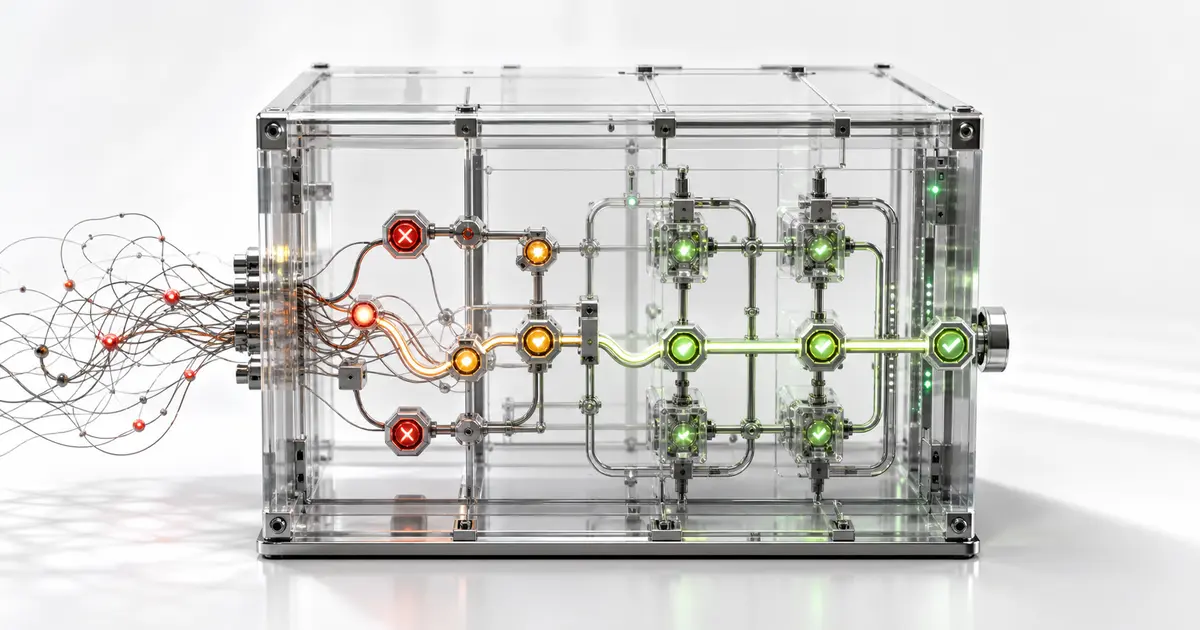
If you have shipped an AI agent, you already know the gap between the demo and production. The demo loops cleanly; production agents stall, hallucinate a tool call, or take an irreversible action no one approved. The lesson of mid-2026 is that learning how to build reliable AI agents is mostly an architecture problem, not a prompt problem. The frameworks and tools trending right now — Apache Burr topping Hacker News, the OpenEnv push for standardized training environments, and human-in-the-loop tooling like Paca and datasette-agent — all attack reliability from the same direction: make the agent's structure explicit, observable, and recoverable instead of hoping a cleverer system prompt holds it together.
This guide walks through that reliability stack so you can see where each piece fits.
Why are most AI agents unreliable?
The typical agent is a loop around a language model: prompt in, tokens out, maybe a tool call, repeat. That design hides everything that matters for reliability. There is no durable record of what state the agent was in, no clean way to replay a failed run, and no enforced boundary before a side effect happens. When something breaks three steps deep, you are left re-reading logs and guessing.
Reliability problems therefore cluster into a few categories: opaque control flow you cannot inspect, non-reproducible runs you cannot debug, no recovery after a crash, and unsupervised actions that should have required a human. Each of the tools below addresses one or more of these directly.
What does it mean to build a reliable AI agent?
A reliable agent is one you can reason about. Concretely, that means four properties:
- Explicit control flow — you can see, as a graph, what the agent can do and how it moves between steps.
- Observability — you can trace any run step by step to understand what happened.
- Reproducibility and recovery — you can replay a run for debugging and resume after a crash instead of starting over.
- Supervised side effects — irreversible or sensitive actions pause for human approval.
None of these come from the model itself. They come from the scaffolding you build around it.
How do state machines make AI agents more reliable?
The clearest expression of the "reliability is architecture" idea is Apache Burr (Incubating), the Python framework whose tagline is literally "build reliable AI agents and applications." It topped Hacker News this week, and the reason it resonates is that it reframes an agent as a state machine rather than an open-ended loop.
In Burr, you build an application as a set of decorated Python functions called actions, connected by explicit transitions, all reading from and writing to a central State object. There is no DSL and no YAML — it is plain Python composed through an ApplicationBuilder(). The resulting application is, in effect, a directed graph of what your agent is allowed to do and when.
That structure is what buys you reliability:
- Built-in observability. Burr ships a dedicated UI for monitoring, debugging, and tracing execution in real time, so a multi-step agent stops being a black box.
- Persistence and resumption. State is saved automatically to disk, a database, or a custom backend, and runs can resume — so a crash mid-workflow is recoverable rather than fatal.
- Reproducibility through replay. You can unit-test individual actions and replay full runs to validate behavior, which turns "it failed once and I can't reproduce it" into a repeatable test.
- Parallelism. It supports parallel actions and fan-out/fan-in patterns for more complex DAGs.
- No lock-in. Burr integrates with OpenAI, Anthropic, LangChain, Streamlit, FastAPI, and PostgreSQL among others, so it slots into an existing stack rather than replacing it.
The takeaway: when your agent's control flow is an inspectable graph with persisted state, most "why did it do that?" questions become answerable.
How do standardized environments improve agent reliability?
Architecture handles a deployed agent's behavior. But agents that learn — via reinforcement learning — are only as reliable as the environments they train and are evaluated in. That is the gap OpenEnv targets.
OpenEnv is an open-source library and protocol layer for creating and standardizing agentic execution environments — terminals, browsers, or any interactive system an agent acts in. The problem it solves is structural: frontier labs like OpenAI, Anthropic, and Meta train their models and harnesses together for efficiency, while open-source developers have to stitch together mismatched harnesses, models, and inference engines by hand. OpenEnv defines a common interface so any model can work with any compliant environment without bespoke glue code.
It does this with a familiar Gymnasium-style API — reset(), step(), and state() — served over standard protocols (HTTP and WebSocket), with environments packaged as Docker containers and the Model Context Protocol (MCP) treated as a first-class citizen. Importantly, OpenEnv is not a reward framework, a training-loop framework, or a single canned environment; it is the interoperability layer underneath those.
Why does this matter for reliability? Because an environment that behaves consistently in training, evaluation, and production is a precondition for an agent that behaves consistently. The effort has notable backing: its June 2026 coordinating committee includes Meta-PyTorch, NVIDIA, Hugging Face, Modal, Prime Intellect, Reflection, Unsloth, Mercor, and Fleet AI, with supporting organizations spanning the PyTorch Foundation, vLLM, and Stanford's Scaling Intelligence Lab among others. Stated priorities include wiring tasksets to Hugging Face datasets, pluggable external rewards, first-class harness support, and end-to-end training examples.
How does human-in-the-loop tooling keep agents safe?
The last layer of reliability is admitting the agent should not act alone. Two fresh releases show what good human-in-the-loop tooling looks like in practice.
What does datasette-agent add for human oversight?
datasette-agent 0.2a0, released by Simon Willison, is an LLM-powered agent for the Datasette data platform, and its 0.2 release is built around supervision. Tools can now ask the user questions mid-execution through a ToolContext object: a tool calls await context.ask_user(...) for a yes/no, multiple-choice, or open-ended answer, and execution suspends until the user responds via a form in the chat. Crucially, suspended conversations survive a server restart — so a pending approval is not lost if the process dies. A new save_query tool shows the full SQL plus the proposed name, database, and visibility, and requires explicit human approval before anything is stored. Side effects, in other words, only occur after a human says yes.
How does Paca structure human-agent collaboration?
Paca is a free, open-source project management tool written in Go — a lightweight alternative to Jira built for teams where, in the creator's words, "humans and AI agents work together as equal teammates to plan sprints and assign tasks." Instead of treating the agent as a hidden background worker, Paca puts coordination in a shared project chat where humans and agents co-plan and assign tasks in real time, as peers. It is self-hostable and extensible through WASM-based plugins, with a deliberately lean core. The reliability angle is organizational: when agent work flows through the same task board and chat as human work, oversight and accountability are built into the workflow rather than bolted on.
How do these tools fit together into a reliability stack?
They are complementary layers, not competitors:
- Architecture (Apache Burr) — model the agent as an explicit, observable, resumable state machine.
- Environments (OpenEnv) — train and evaluate against standardized, reproducible environments so behavior carries from simulation to production.
- Human-in-the-loop (datasette-agent, Paca) — gate side effects behind approval and route agent work through human-visible coordination.
You do not need all three on day one. But the pattern across mid-2026's most-discussed agent tooling is unmistakable: reliability is engineered into the system's structure, not prompted into the model.
Key takeaways
- Reliability is architecture. Explicit control flow, observability, reproducibility, and supervised side effects are properties of your scaffolding, not your prompt.
- Make control flow a graph. State-machine frameworks like Apache Burr give you inspectable, persistable, replayable agents without framework lock-in.
- Standardize what your agent learns in. OpenEnv's common interface for RL environments closes the infrastructure gap between open-source and frontier-lab agent training.
- Keep a human in the loop for anything irreversible. Tools like datasette-agent and Paca show that pausing for approval and sharing a workspace with humans are practical, shippable patterns.
Building dependable agents is the core of what we cover at Clawvard. If this was useful, explore our other agent-building and model-evaluation guides, try Clawvard for your own agent workflows, and follow along for updates as this tooling matures.
Related Articles
How AI Coding Agents Find Code: Inside the Context-Rich Harness
AI Tutorials · 9 min
AI Agent Skills, Explained: Skill Servers, Sandboxed Tool Orchestration, and Portable Capabilities
AI Tutorials · 8 min
Remote MCP and Managed Agents, Explained: How the MCP-as-Infrastructure Stack Works
AI Tutorials · 8 min