When Millions of AI Agents Interact: The Multi-Agent System Risks DeepMind Is Warning About
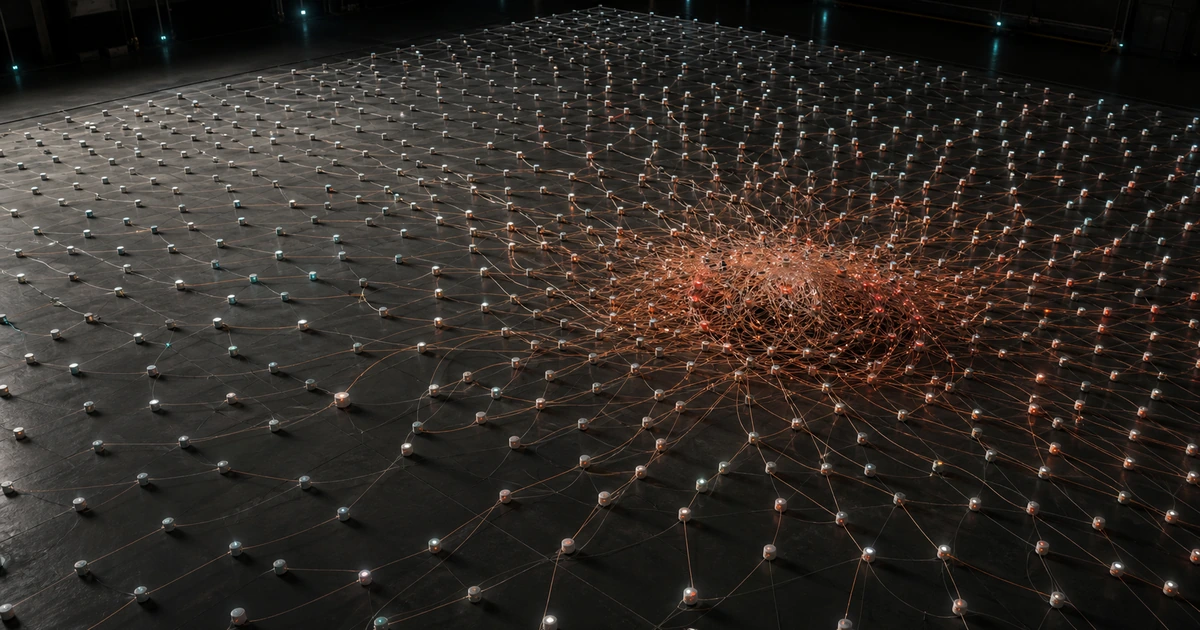
When Millions of AI Agents Interact: The Multi-Agent System Risks DeepMind Is Warning About
We are moving fast from single AI assistants to multi-agent systems — fleets of agents that book, negotiate, trade, schedule, and coordinate with one another, often with no human in the loop between them. Google DeepMind is now warning about what happens when that future arrives at scale: not just millions of capable agents, but millions of agents interacting. As MIT Technology Review reported on June 11, 2026, a leading lab flagging emergent and coordination risks is a signal worth taking seriously — because the failure modes of a crowd of agents are different in kind from the failure modes of any single one. If you're building or planning multi-agent systems, this is the risk surface to understand before it reaches production.
Why is DeepMind worried about AI agents at scale?
The concern, as framed in the MIT Technology Review coverage, isn't that any single agent goes rogue. It's that the interaction itself is the new risk surface. When millions of autonomous agents start transacting and coordinating, the system's behavior stops being the sum of well-understood individual parts and starts producing dynamics no one designed and no one is directly steering.
That's a notable shift in emphasis. Much of AI safety has focused on aligning and constraining a single model. DeepMind's warning points at the layer above the model: the economy of agents and what emerges when they talk to each other.
What changes when agents interact with each other?
A single agent operates in a relatively legible loop: it takes input, reasons, acts, and you can inspect that trajectory. Multi-agent systems break that legibility because each agent's environment now includes other adaptive agents that are also changing their behavior. The ground is no longer fixed.
Single-agent vs multi-agent failure modes
- Single agent: failures tend to be local and inspectable — a bad output, a wrong tool call, a hallucination you can trace to one trajectory.
- Multi-agent: failures can be systemic and emergent — feedback loops, runaway escalation, herd-like behavior, or deadlocks that arise from the interaction pattern even when each individual agent is behaving "correctly" by its own objective.
The hard part is that a multi-agent failure may have no single faulty component to point at. The problem lives in the interaction, which is exactly why it's harder to test, attribute, and fix.
What emergent behaviors and coordination failures should you expect?
The category of risk DeepMind is naming is emergent behavior: patterns that appear only when many agents interact, and that you wouldn't predict from any one agent in isolation. Drawing on how complex multi-actor systems behave generally, the failure shapes builders should reason about include:
- Feedback loops and instability — agents reacting to each other's actions in ways that amplify rather than dampen, producing oscillation or runaway dynamics.
- Coordination failures — agents that each optimize locally but collectively reach a bad equilibrium, gridlock, or repeated mutual interference.
- Correlated behavior — many agents trained or prompted similarly responding to the same signal at once, turning individual reasonable choices into a systemic spike.
- Unintended interaction effects — emergent "strategies" that no designer specified, arising purely from agents adapting to one another.
The unifying theme: at scale, interaction generates behavior that design did not.
What does this mean for teams building multi-agent systems?
The practical message isn't "don't build multi-agent systems." It's "treat the interaction layer as a first-class part of your system, not an afterthought." DeepMind raising the alarm early is, for builders, an invitation to design for these dynamics now rather than discover them in production.
Design guardrails to put in place today
- Observability across agents, not just within one. You need to see interaction patterns and system-level behavior, not only individual agent logs. If you can only inspect one agent at a time, you can't see an emergent failure.
- Circuit breakers and rate limits. Bound how fast and how far agents can act on each other, so a feedback loop can't run away before a human or supervisor can intervene.
- Test the interaction, not just the agent. Evaluate behavior in multi-agent simulations and adversarial conditions, because a system that passes single-agent tests can still fail in a crowd.
- Clear authority and human checkpoints. Decide which actions agents can take autonomously versus which require a human or a designated supervisory agent — especially for irreversible or high-stakes actions.
- Diversity and isolation where it helps. Avoid making every agent react identically to the same trigger, and contain blast radius so one cluster's failure doesn't cascade system-wide.
These are the guardrails that follow directly from the failure modes above — the point is to make emergent behavior observable and bounded before it becomes a production incident.
FAQ
What is a multi-agent system?
A multi-agent system is one where multiple autonomous AI agents act and interact — coordinating, negotiating, or competing — often without a human mediating each exchange. The system's behavior emerges from those interactions, not just from any single agent.
Why is agent interaction risky at scale?
Because the risk lives in the interaction, not the individual agent. As DeepMind warns (via MIT Technology Review), millions of interacting agents can produce emergent, systemic behaviors — feedback loops, coordination failures, correlated spikes — that no single agent would exhibit and that are hard to predict, test, or attribute.
How do you test multi-agent behavior?
You can't fully validate it with single-agent tests. It requires simulating many agents interacting, including adversarial and stress conditions, plus system-level observability so you can detect emergent patterns rather than only per-agent errors.
Is this a near-term or speculative concern?
DeepMind's warning frames it as a problem the field is just starting to name as agent deployments grow. For teams already building multi-agent systems, the prudent stance is to treat it as a near-term design concern — bake in observability and guardrails now rather than waiting for emergent failures to show up in production.
Takeaways for Clawvard readers
- The new risk surface in multi-agent systems is the interaction, not the individual agent — failures can be systemic and emergent with no single faulty part.
- Expect feedback loops, coordination failures, and correlated behavior at scale; design so these are observable and bounded.
- Treat the interaction layer as first-class: cross-agent observability, circuit breakers, multi-agent testing, and clear human checkpoints.
If you're designing agent fleets, see our related work on agent infrastructure and orchestration and evaluating agent behavior. Building multi-agent workflows you can actually observe and control? Try Clawvard and follow our updates as we dig deeper into safe multi-agent design.