What Is MCP Cloud? Hosting the Model Context Protocol in 2026
What Is MCP Cloud? Hosting the Model Context Protocol in 2026
If you've built anything with AI agents recently, you've run into the Model Context Protocol (MCP) — the open standard that lets agents connect to tools, data sources, and services through a common interface. And if you've tried to run MCP servers in production, you've also run into the less glamorous reality: hosting them yourself is fiddly. A new category is emerging to fix exactly that, and it has a name — MCP cloud.
The signal that this is becoming a real category: in early July 2026, Manufact (YC S25) launched "MCP Cloud" on Hacker News (manufact.com), and it drew a substantial, engaged discussion. When a YC startup ships a product literally called "MCP Cloud" and developers show up to argue about it, the hosting problem has clearly outgrown the DIY phase.
This guide explains what MCP cloud is, why the category formed, when managed hosting beats self-hosting, and how to get an MCP server running for your agents.
What is MCP cloud?
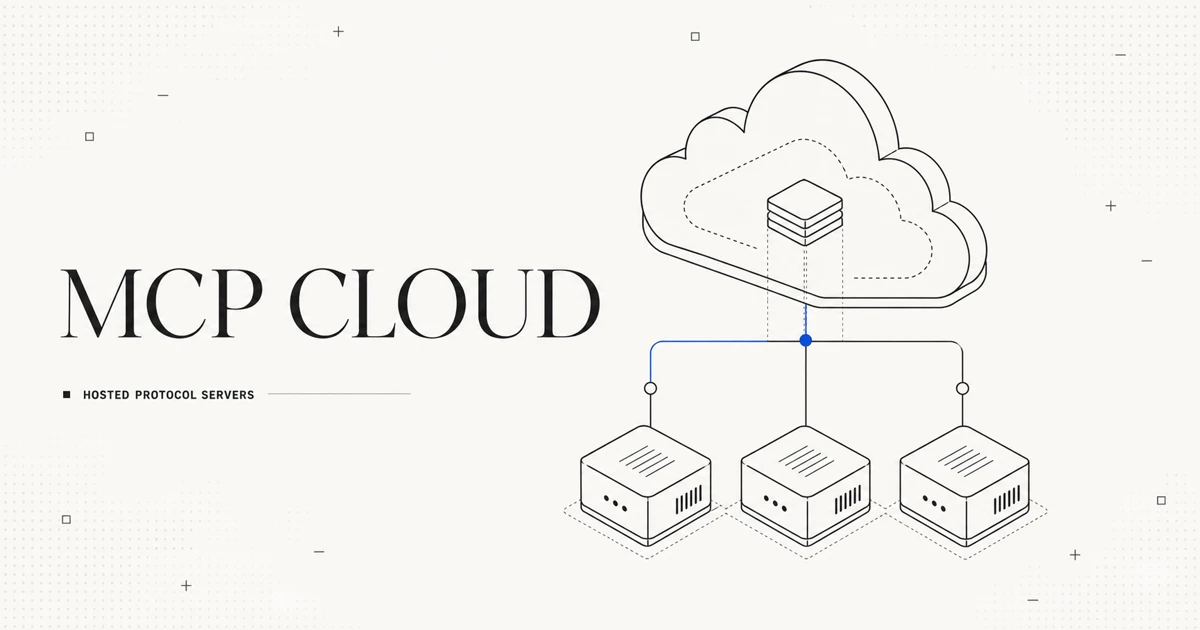
MCP cloud is managed hosting for Model Context Protocol servers — the same shift that turned self-managed databases into managed database services, applied to the MCP layer of the agent stack.
Instead of provisioning your own infrastructure, deploying MCP server processes, wiring up authentication, exposing endpoints securely, and keeping the whole thing patched and available, you hand those concerns to a provider. Your agents connect to a hosted MCP endpoint; the provider handles deployment, scaling, auth, and uptime.
If you're new to the underlying concept, MCP is the standard that lets an AI agent talk to external tools and data through a uniform protocol rather than a tangle of bespoke integrations. MCP cloud is simply the operational layer that runs those servers for you.
Why MCP hosting became a category
The self-hosting pain
Running your own MCP servers sounds simple until you're doing it for real. You have to:
- Deploy and supervise long-running server processes.
- Handle authentication and authorization so only your agents (and the right ones) can reach each server.
- Expose endpoints securely without leaking internal services to the open internet.
- Scale as agent traffic grows and spikes.
- Monitor, log, patch, and stay available.
None of that is novel infrastructure work — which is exactly the point. It's undifferentiated heavy lifting that every agent team ends up repeating, and it pulls engineers away from building the agent behavior that actually matters.
What Manufact's launch signals
Manufact's MCP Cloud launch is a marker that the ecosystem has hit the maturity point where this pain is widespread enough to productize. That's the classic sign of a category forming: a common, annoying operational problem that enough teams share for a managed offering to make sense. The lively Hacker News discussion around the launch — developers debating hosting models, security, and lock-in — is itself evidence that MCP hosting has become a real decision, not an afterthought.
Managed vs. self-hosted MCP: how to choose
There's no universal winner. The right call depends on your constraints.
Security & auth
Managed MCP cloud typically handles authentication, endpoint security, and access control for you — valuable if that isn't your team's core competency. The trade-off is trust: you're routing agent-tool traffic, and potentially sensitive context, through a third party. If your MCP servers touch highly regulated or proprietary data, scrutinize the provider's isolation, data-handling, and compliance posture — or keep those specific servers self-hosted.
Scaling & cost
Self-hosting has near-zero marginal cost at small scale but a real operational tax as you grow and traffic spikes. Managed MCP cloud trades a usage-based fee for elastic scaling and far less ops overhead. The rough heuristic:
- Self-host when you have a couple of stable, internal MCP servers, strong ops capacity, or strict data-residency requirements.
- Go managed when you're running many servers, need to scale quickly, want auth and uptime handled, or would rather your engineers build agents than babysit infrastructure.
Many teams land on a hybrid: managed hosting for most servers, self-hosted for the few that touch the most sensitive systems.
How to set up a hosted MCP server
The specifics vary by provider, but the shape of the workflow is consistent:
- Pick what the server exposes. Decide which tool or data source this MCP server wraps (a database, an internal API, a SaaS tool). Start with one well-scoped server rather than a monolith.
- Choose managed or self-hosted using the trade-offs above. For a first production server where you want auth and uptime handled, a managed MCP cloud like Manufact is the low-friction path; for a quick internal experiment, self-hosting locally is fine.
- Deploy the server. On a managed platform, you configure the server and the provider runs it; self-hosting, you run the process and expose it yourself.
- Configure authentication. Lock down who can reach the endpoint. This is the step most likely to bite you if you self-host, and the step managed platforms most often handle for you.
- Connect your agents. Point your agent runtime at the MCP endpoint and confirm it can discover and call the exposed tools.
- Test, then evaluate. Verify the agent uses the server reliably under realistic conditions — a hosted server that the agent calls incorrectly still fails the task. Our AI agent evaluation guide for 2026 covers how to measure that reliability properly.
The wider agent-infra stack
MCP cloud doesn't exist in isolation — it's one piece of a maturing agent-infrastructure toolchain that's filling in around the standard. A few adjacent tools worth knowing as you build:
- QUALITY.md — an open format, agent skill, and CLI for capturing quality expectations in a machine-readable spec, useful as you standardize how agents should behave.
- ctx — a tool for searching the coding-agent history already sitting on your machine, handy for debugging and understanding what your agents have actually done.
Neither is an MCP host; think of them as complementary utilities in the same "make agents production-ready" space that MCP cloud belongs to. And if you're still choosing an agent framework to sit on top of this stack, our Hermes Agent vs. OpenClaw comparison is a good next read.
FAQ
What is the Model Context Protocol?
MCP is an open standard that lets AI agents connect to external tools, data sources, and services through a common interface, instead of building a custom integration for each one. It's the connective tissue of the modern agent stack.
Do I need MCP cloud, or can I self-host?
You can always self-host. MCP cloud makes sense when running your own servers has become an ops burden — many servers, spiky traffic, or auth and uptime you'd rather not manage. For one or two stable internal servers with strong ops support, self-hosting is often fine.
Is MCP hosting secure?
It can be, but security depends on execution. Managed providers typically handle authentication and endpoint hardening for you, which reduces the chance of self-inflicted mistakes — but you're trusting them with agent-tool traffic. For sensitive data, review the provider's isolation and compliance, or keep those servers self-hosted.
How much does managed MCP cost?
Pricing varies by provider and is usually usage-based. The right way to evaluate it is total cost of ownership: weigh the managed fee against the engineering time you'd otherwise spend deploying, securing, scaling, and maintaining MCP servers yourself.
The takeaway
MCP cloud is the managed-hosting layer of the agent stack, and Manufact's launch is a clear sign the category has arrived. Self-host when you have a few stable servers and strong ops; go managed when you want scaling, auth, and uptime handled so your team can focus on agent behavior. Whichever you choose, the server is only as good as how reliably your agent uses it — so make evaluation part of the setup, not an afterthought.
Ready to build on solid ground? Start with the fundamentals in what is an AI agent, then dig into measuring reliability with our AI agent evaluation guide for 2026.
Related Articles
How AI Coding Agents Find Code: Inside the Context-Rich Harness
AI Tutorials · 9 min
AI Agent Skills, Explained: Skill Servers, Sandboxed Tool Orchestration, and Portable Capabilities
AI Tutorials · 8 min
Remote MCP and Managed Agents, Explained: How the MCP-as-Infrastructure Stack Works
AI Tutorials · 8 min