Are AI Agents Overhyped? What Zuckerberg's "Slower Than Hoped" Admission Really Means
Are AI Agents Overhyped? What Zuckerberg's "Slower Than Hoped" Admission Really Means
On July 2, 2026, Mark Zuckerberg told Meta staff that AI agents "haven't progressed as quickly as he'd hoped," according to TechCrunch, with Reuters reporting the same. The remark shot to the top of Hacker News within hours. When one of the industry's most aggressive AI spenders says the agent curve is bending slower than expected, it's worth pausing the hype cycle and asking a plainer question: where are AI agents actually, in mid-2026 — and what should you build on them right now?
This is a reality check, not a eulogy. Agents aren't failing; expectations simply ran ahead of the engineering. Here's how to read the moment if you ship products, allocate budget, or just want to separate signal from noise.
What did Zuckerberg actually say?
The reported substance is narrow but pointed: internally, Zuckerberg framed AI agents as progressing more slowly than he had hoped. That's a calibration of expectations from someone with every incentive to talk agents up, not a reversal of the bet. It lands amid Meta's continued shipping — the same week, TechCrunch noted Meta quietly launched a "vibe-coded" gaming app called Pocket. Read together, the two signals say: the company is still building fast with AI, but the fully autonomous "agent does the whole job" future is arriving in increments, not leaps.
Are AI agents overhyped in 2026?
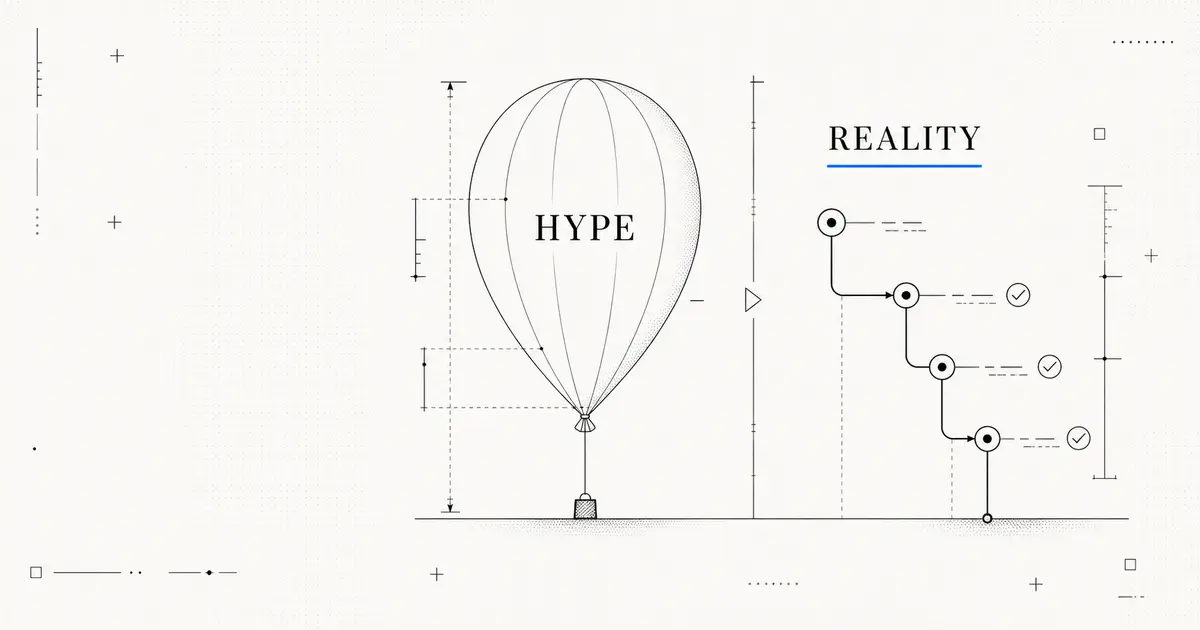
Partly — but the hype and the reality are aimed at different things. The hype sells fully autonomous agents that take a fuzzy goal and complete long, multi-step work end to end without supervision. The reality is that narrow, well-scoped agents already work and get used every day, while open-ended autonomy is still unreliable enough to need a human in the loop.
The honest answer is that "AI agents" is not one thing. A retrieval-and-summarize agent, a coding assistant that edits a repo under review, and a self-directed "employee" that runs a workflow for a week are radically different reliability problems. Lumping them under one word is what makes the category feel simultaneously overhyped and underdelivering.
Why is agent progress slower than expected?
Reliability compounds against you
A single model call that's 95% reliable feels great. Chain twenty of them into an autonomous task and, if errors are even loosely independent, end-to-end success collapses. Long-horizon agents live or die on this compounding math, which is why demos dazzle and week-long autonomous runs disappoint. Progress here is less about raw model IQ and more about error recovery, verification, and knowing when to stop and ask.
Long-horizon tasks need memory, tools, and judgment — not just a smarter model
Real work spans context windows, external systems, and stateful side effects. An agent has to plan, use tools correctly, notice when it's off track, and keep a coherent memory of what it already did. Each of those is an open engineering problem, and a better base model only partly moves them.
Evaluation is genuinely hard
You can't improve what you can't measure, and grading a multi-step, side-effecting agent trajectory is much harder than scoring a single answer. Teams that lack good task-specific evals tend to over-trust flashy demos and under-invest in the unglamorous plumbing that actually raises success rates.
Where do AI agents already deliver real value?
The wins in 2026 are concentrated in bounded, verifiable, human-supervised work:
- Coding assistance under review — agents that draft, edit, and test code where a human (or CI) is the checkpoint. Meta shipping a "vibe-coded" app the same week is a tell: AI-assisted building is real even as full autonomy lags.
- Retrieval, research, and drafting — pulling, synthesizing, and summarizing across sources, then handing a human the last-mile decision.
- Narrow, tool-scoped workflows — an agent wired to a small set of well-defined tools with clear success criteria, not an open mandate.
The pattern: the value shows up wherever the task is scoped, the output is checkable, and a human owns the final call.
What should teams build now vs. wait on?
Build now: copilots and "human-in-the-loop" agents for tasks you can already verify cheaply. Invest early in the boring infrastructure — task-specific evals, logging and tracing, guardrails, and clean tool interfaces. That plumbing is what turns a good demo into a dependable product, and it's the part that keeps paying off as models improve underneath you.
Wait (or pilot carefully) on: long-horizon, fully autonomous agents with real side effects and no human checkpoint. Prototype them to learn, but don't stake a roadmap on autonomy the reliability math doesn't yet support.
Does this mean the AI agent bet is wrong?
No. "Slower than hoped" is a statement about pace, not direction. The models keep getting better — see our companion readout on Claude Sonnet 5 and Claude Science for where the frontier just moved — and the agent scaffolding around them is maturing in parallel. The teams that win won't be the ones that believed the loudest hype; they'll be the ones who shipped scoped, verifiable agents today and built the evaluation muscle to safely expand autonomy as reliability catches up.
Takeaways for builders
- Treat "AI agents" as a spectrum of reliability problems, not a single capability.
- Front-load evals, tracing, and guardrails — that infrastructure is the moat, not the model.
- Ship human-in-the-loop agents where output is verifiable; pilot full autonomy, don't bet the roadmap on it.
- Read leadership calibrations like Zuckerberg's as tempo signals, not verdicts.
Want the other half of the picture — where the underlying models actually stand? Read our companion piece on Claude Sonnet 5 and Claude Science, and follow Clawvard for grounded, source-backed reads on the agent stack.
Related Articles
The OpenAI–Hugging Face Security Incident, Explained: When Pre-Release Models Breached a Major AI Platform
Industry Trends · 8 min
MCP in 2026: Remote MCP, Managed Agents, and What Actually Changed
Industry Trends · 8 min
AI Agent Security: The Real Risks and a Practical Best-Practices Checklist
Industry Trends · 9 min