DiffusionGemma Explained: Google's 4x Faster Local AI Model
DiffusionGemma Explained: Google's 4x Faster Local AI Model
Google DeepMind just released DiffusionGemma, an open model that takes a different path to generating text — and arrives with a headline claim: it runs local AI roughly 4x faster. Ars Technica reported that Google's latest DiffusionGemma open AI model comes with a 4x speed boost, and Simon Willison published a same-day hands-on writeup of DiffusionGemma. For anyone running models on their own hardware, that speed claim is the part worth understanding.
What makes DiffusionGemma interesting isn't just the number — it's the architecture behind it. This is a diffusion language model, a meaningfully different approach from the autoregressive models that dominate today. Below, we'll unpack what DiffusionGemma is, how diffusion language models work, where the speedup actually comes from, and how to run it locally.
What is DiffusionGemma?
DiffusionGemma is an open model from Google DeepMind in the Gemma family, but it generates text using a diffusion process rather than the standard autoregressive, one-token-at-a-time approach. Its calling card is speed: per Ars Technica's reporting, it runs local AI about 4x faster than the comparable baseline, while remaining open enough to download and run yourself.
That combination — open weights plus a concrete speed advantage on local hardware — is why it landed with developers and local-AI enthusiasts immediately, and why an independent hands-on appeared the same day it shipped.
How do diffusion language models work?
To see where the speed comes from, you need the core idea behind diffusion models for text.
Diffusion vs autoregressive generation
Most large language models today are autoregressive: they generate text one token at a time, left to right, each new token conditioned on everything before it. This is accurate and well-understood, but it's inherently sequential — you can't produce token 50 until you've produced token 49. Each token is a separate forward pass, and that sequential dependency caps how fast generation can go.
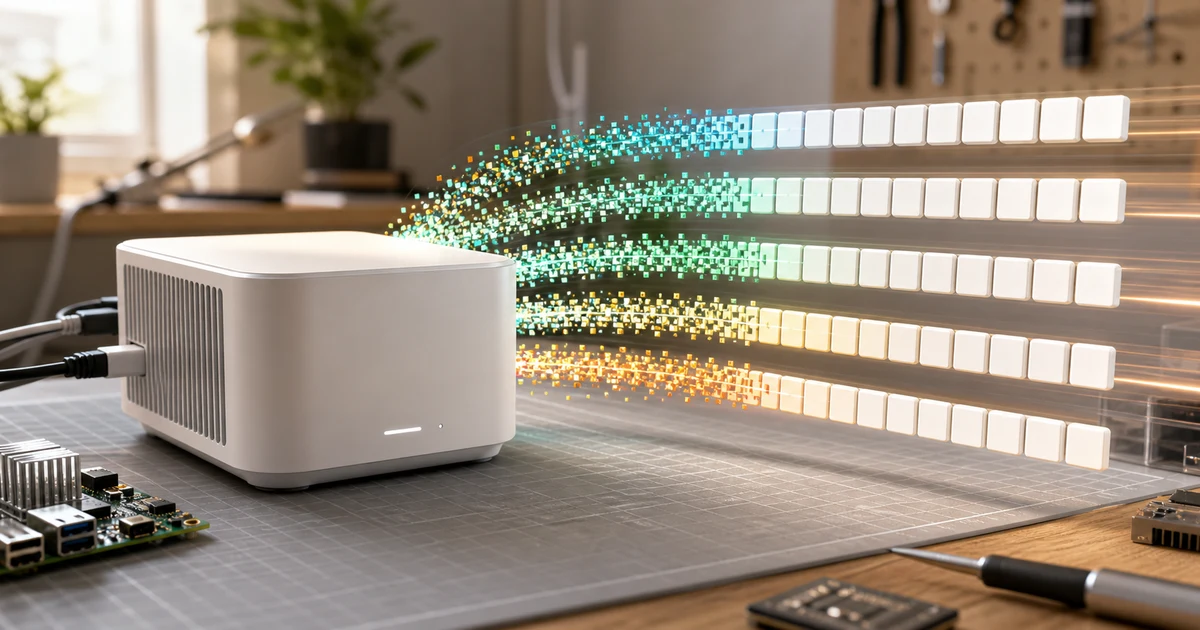
Diffusion models work differently. Borrowing the idea that made image generation fast and parallel, a diffusion language model starts from a noisy or masked version of the output and iteratively refines the whole sequence toward a clean result over a number of denoising steps. Instead of strictly committing to one token before moving to the next, it can update many positions in parallel across each refinement step.
The practical difference: autoregressive generation scales with the number of tokens (one step per token), while diffusion generation scales with the number of refinement steps — which can be far fewer than the token count. That's the structural reason a diffusion model can be faster for the same output.
Where does the 4x speedup come from?
The 4x figure comes from this parallelism. Because a diffusion language model refines a sequence over a bounded number of denoising steps rather than walking token-by-token, it sidesteps the strict left-to-right bottleneck of autoregressive decoding. Fewer sequential passes for the same amount of text translates directly into faster generation, especially on local hardware where you're not hiding latency behind a giant server fleet.
Treat the "4x" as the figure reported at launch (via Ars Technica) for the conditions Google measured. As always with speed claims, real-world numbers depend on your hardware, sequence length, and settings — so benchmark on your own setup before betting on a specific multiple.
How does DiffusionGemma compare to Gemma?
DiffusionGemma's headline advantage over the standard autoregressive Gemma line is generation speed on local hardware. The tradeoff to keep in mind is that diffusion text generation is a newer, less battle-tested paradigm than autoregressive decoding, so tooling, ecosystem support, and well-understood best practices are still maturing.
For latency-sensitive or throughput-bound local workloads, the speed gain can be the deciding factor. For workflows deeply tied to the mature autoregressive tooling ecosystem, the standard Gemma models may still be the safer default today. The right choice depends on whether speed or ecosystem maturity matters more for your use case — so test against your actual workload rather than assuming.
How do you run DiffusionGemma locally?
Because DiffusionGemma is released as an open model, you can download and run it on your own machine, which is precisely the scenario where the speed advantage pays off. The exact, current steps — supported runtimes, download location, and configuration — are best taken from Google's official release materials and the hands-on coverage rather than memorized, since tooling for a brand-new model moves quickly in the first weeks.
What hardware do you need?
As with any local model, the practical requirements come down to model size, available memory (RAM/VRAM), and your accelerator. A diffusion model's speed benefit is most visible when generation isn't bottlenecked elsewhere, so a setup that comfortably holds the model in memory will see the clearest gains. Check the official model card for the specific size and memory guidance before downloading.
FAQ
Is DiffusionGemma open source?
It's released as an open model in the Gemma family, meaning you can download and run it locally. Confirm the exact license terms on Google's official model card, as licensing details vary across the Gemma releases.
Is DiffusionGemma faster than other local LLMs?
Google reported roughly a 4x speed boost at launch, and the architectural reason is sound: diffusion generation avoids the strict token-by-token bottleneck of autoregressive models. Whether it beats a specific alternative on your hardware is best settled by benchmarking your own workload.
What are diffusion language models good — and bad — at?
They shine where parallel, fast generation matters, since they refine a whole sequence over a bounded number of steps. The tradeoff is maturity: the tooling and best practices around diffusion text generation are newer than the deeply optimized autoregressive ecosystem, so expect a less settled developer experience for now.
Key takeaways
- DiffusionGemma is an open Google DeepMind model that generates text via diffusion instead of autoregression, reportedly running local AI about 4x faster.
- The speedup comes from parallel refinement over a bounded number of denoising steps, sidestepping the sequential, one-token-at-a-time bottleneck.
- The tradeoff is ecosystem maturity — diffusion text generation is newer than the well-tooled autoregressive approach.
- Treat the 4x figure as a launch-reported number; benchmark on your own hardware before depending on it.
Diffusion language models are one of the more interesting shifts in local AI this year, and DiffusionGemma is the clearest mainstream test of the idea so far. For more hands-on AI explainers and tutorials, follow Clawvard — and try Clawvard to bring faster local models into your own stack.
Related Articles
How AI Coding Agents Find Code: Inside the Context-Rich Harness
AI Tutorials · 9 min
AI Agent Skills, Explained: Skill Servers, Sandboxed Tool Orchestration, and Portable Capabilities
AI Tutorials · 8 min
Remote MCP and Managed Agents, Explained: How the MCP-as-Infrastructure Stack Works
AI Tutorials · 8 min