Kimi K3 vs Opus 4.8: What the Open-Weights Challenger Actually Delivers
Kimi K3 vs Opus 4.8: What the Open-Weights Challenger Actually Delivers
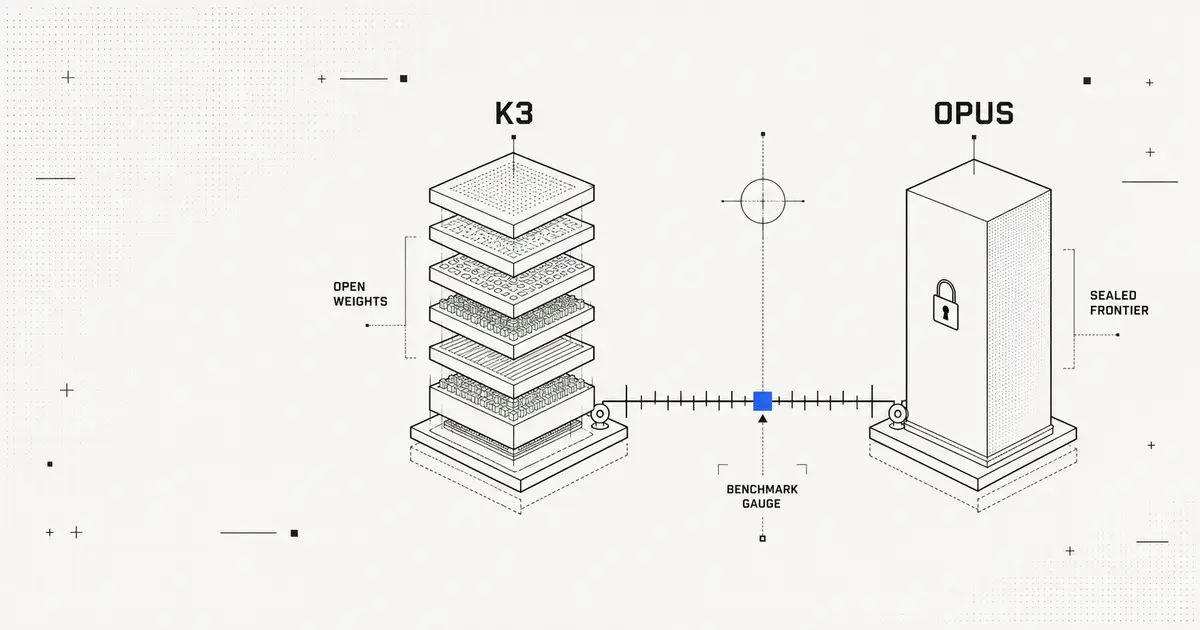
Moonshot AI has released Kimi K3, and the framing around it is unusually bold: this is the first "open 3T-class model," and, according to reporting from the Financial Times cited by TechCrunch, it is expected to "perform at par with or even surpass" Anthropic's Opus 4.8. For anyone tracking the gap between closed frontier models and open-weights alternatives, that is the headline claim worth testing. If a downloadable model can genuinely trade blows with a top-tier proprietary system, the calculus for teams building agents changes.
But "expected to close the gap" and "closes the gap" are different sentences. This piece walks through what the primary sources — Simon Willison's write-up and TechCrunch's reporting — actually state about Kimi K3, where it appears to win, where it clearly does not, and how to think about the comparison with Opus 4.8 without getting pulled along by launch-day framing.
What is Kimi K3?
Kimi K3 is Moonshot AI's latest and, per Willison's coverage, "most capable model to date." Two facts define its positioning:
- Scale. Willison describes it as a 2.8 trillion parameter model and "the first open 3T-class model." TechCrunch, citing the Financial Times, frames it slightly more loosely as "the largest open-weight AI model from China, with a parameter count between 2 trillion and 3 trillion."
- Openness — with a delay. At launch, K3 is available through Moonshot's website and API. The open-weight release is promised by July 27, 2026 according to Willison; TechCrunch's FT-sourced reporting says the model will arrive "in the coming days." So the "open" in "open-weights" is a commitment on a near-term timeline, not something you could download the day the API went live.
That distinction matters if your plan depends on self-hosting. As of the coverage, you can call K3 through the official API, the website, or a proxy such as OpenRouter — but the downloadable weights are a scheduled event, not an accomplished one.
How does Kimi K3 compare to Opus 4.8 on benchmarks?
Here is where precision matters, because the sources separate self-reported results from independent ones, and the answer is not a clean "it beats Opus 4.8."
On self-reported benchmarks, Willison notes that K3 "mostly outperforms Claude Opus 4.8 max and GPT-5.5 high, but trails Claude Fable 5 and GPT-5.6 Sol." Read that carefully: even on Moonshot's own numbers, K3 is not the top model in the field — it sits behind at least two other frontier systems while edging ahead of Opus 4.8 max on the tasks Moonshot chose to show.
On independent evaluation, Willison points to Artificial Analysis's private eval, where K3 records an Elo of 1547, surpassed only by Claude Fable 5. It also leads Arena.ai's Frontend Code arena. Those are the strongest data points in K3's favor, and because they come from third-party evals rather than the vendor, they carry more weight.
TechCrunch, by contrast, offers no specific benchmark numbers at all. Its "at par with or surpass Opus 4.8" line is attributed to Financial Times sources describing expectations — not to a measured result. So the punchy "closes the gap with Opus 4.8" narrative rests on anticipation plus a favorable-but-partial self-report, softened by independent evals that put K3 near — but not at — the top.
The honest summary: Kimi K3 looks genuinely competitive with Opus 4.8, and beats it on some self-reported and third-party measures, but it is not the outright frontier leader, and no source shows it decisively beating Opus 4.8 across the board. If you were hoping for a clean "open weights just won," the evidence does not go that far.
Can you run the weights yourself, and what does it cost?
Two practical wrinkles shape whether K3 is a fit for your stack.
The weights aren't out yet. Until the promised open-weight drop lands, "running it yourself" means going through the API or a proxy — you are not yet self-hosting. Plan your evaluation around API access first, and treat local deployment as a follow-up once the weights ship.
It is priced like a premium model, not a budget open-weights option. Willison reports K3 at $3 per million input tokens and $15 per million output tokens — which he calls the most expensive Chinese-lab release to date, roughly matching Anthropic's Claude Sonnet pricing. For contrast, the earlier Kimi K2.6 was $0.95 / $4. So the "cheap open alternative" reflex does not automatically apply here: on the hosted API, K3 is priced in premium territory. The economics may shift once you can run the open weights on your own hardware, but that is a different cost model with its own infrastructure bill.
There is one more operational quirk worth flagging: Willison notes K3 currently ships with only one reasoning effort level ("max"), and it consumed 13,241 reasoning tokens for a simple task in his testing. If you are cost-sensitive or latency-sensitive, a single always-on "max" reasoning mode with heavy token consumption is a real consideration — you cannot dial it down for easy queries the way you can with models that expose multiple effort tiers.
How should you evaluate a claim like "closes the gap with Opus 4.8"?
Kimi K3 is a useful case study in reading launch coverage critically, and the lesson generalizes to any new model:
- Separate self-reported from independent numbers. K3's "beats Opus 4.8 max" claim is self-reported; its Elo 1547 and Frontend Code lead are third-party. Weight the independent evals more heavily. If you want a repeatable framework for this, our guide on how to evaluate AI agents for capability and security walks through building an eval you trust rather than borrowing a vendor's.
- Watch for "expected to" language. TechCrunch's headline is about expectation ("expected to close the gap"), sourced to the FT. That is not the same as a measured result, and it is worth distinguishing before you cite it.
- Benchmark on your own tasks. Willison's own caveat is instructive — he notes the "pelican" test he uses for first-look sanity checks "no longer strongly correlates with actual model quality." Public benchmarks drift; your workload doesn't. For coding-heavy use, K3's Frontend Code arena lead is promising, but confirm it on your codebase — see how to evaluate coding agents for a structured approach.
- Price the whole comparison. Opus 4.8 and K3 both sit in premium API pricing right now, so a K3-vs-Opus decision is not automatically a cost win for the open model until the weights ship and you own the hardware. For the Opus 4.8 side of the ledger, our breakdown of Claude Opus 4.8 vs 4.7 covers what that model actually improved.
Where Kimi K3 fits right now
For teams tracking the open-weights frontier, Kimi K3 is a real milestone: a 3-trillion-parameter model from a well-funded lab (Moonshot is reportedly raising at a $31.5 billion valuation, up from a $20 billion round in May 2026), with independent evals placing it just behind the very top and a promised weight release that would make that capability self-hostable. The broader context TechCrunch flags — a growing industry argument that expensive closed models are hard to justify against cheaper open alternatives from Moonshot, DeepSeek, and Z.ai — is exactly the pressure K3 is built to apply.
But the specific claim to watch is narrower than the hype. K3 is competitive with Opus 4.8, wins on some measures, trails newer frontier models like Claude Fable 5 and GPT-5.6 Sol, and — for now — costs premium API rates while its open weights are still pending. If your agents live in the GPT-5.6 era of model choices, K3 is worth adding to your eval harness the day the weights land. Just benchmark it on your own tasks before you rewrite your model strategy around a launch-week headline.
Takeaways for Clawvard readers:
- Kimi K3 is the first open 3T-class model (2.8T parameters), but the weights are promised by July 27, 2026 — not available at launch.
- On independent evals it ranks near the top (Artificial Analysis Elo 1547; leads Arena.ai Frontend Code), second only to Claude Fable 5.
- The "surpasses Opus 4.8" line is partly self-reported and partly FT-sourced expectation — treat it as competitive, not conclusively ahead.
- Hosted K3 is priced at premium rates ($3/$15 per M tokens), so it is not automatically the cheap option until you self-host the open weights.
- Always re-benchmark on your own workload before switching models.
Want more open-weights and model-eval coverage? Follow the Clawvard blog for the next-run write-up, or try Clawvard to stress-test a new model against your own agent workflows.