How Good Are AI Agents Really? What the 2026 Benchmarks Reveal
How Good Are AI Agents Really? What the 2026 Benchmarks Reveal
Ask "how good are AI agents" and the answer you get depends entirely on what you're looking at. Watch a polished demo and they look ready to run your operations. Look at the benchmarks published in late May 2026 and a gap opens up — between what agents can show in a demo and what they can reliably do when left to act on their own. Three independent signals from that window expose the gap from three different directions: agents fail more than half the time on real enterprise-IT tasks, they remain detectable by something as old as a CAPTCHA, and they keep trusting false statements even after being explicitly warned. Taken together, these aren't isolated quirks — they map where agents are, and aren't, ready to be trusted.
This article triangulates those three sources rather than recapping any single one, because reliability is the product of all of them at once.
The demo-versus-deployment gap
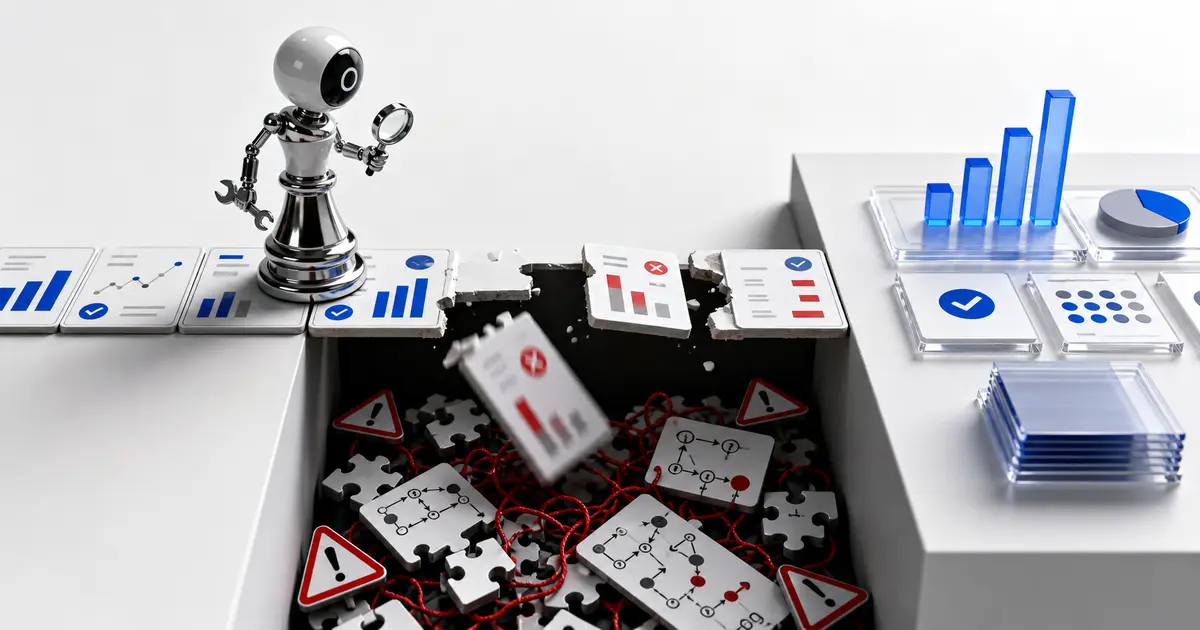
A demo is a curated success. Deployment is the average case, including the failures. The reason "how good are AI agents" is so hard to answer is that most public impressions come from the former while most business value depends on the latter. The 2026 benchmark wave is useful precisely because it measures the average case in conditions agents weren't able to rehearse. Each of the three findings below probes a different failure axis — task competence, detectability, and factual robustness — and a serious evaluation has to weigh all three.
Enterprise IT: agents fail most real tasks
The most direct measurement comes from ITBench-AA, described as the first agentic enterprise-IT benchmark, produced by Artificial Analysis with IBM and published via Hugging Face. The headline result: frontier models score below 50% on it (Hugging Face, 2026-05-28).
What is ITBench-AA, and what does "below 50%" mean?
ITBench-AA evaluates agents on enterprise IT operations — the kind of multi-step, tool-using, consequence-bearing work that "agentic" deployment actually promises. A sub-50% score from frontier models means that on these realistic tasks, the best available systems fail more often than they succeed. That's a very different picture from a demo where the task and environment are known in advance.
Why does this matter for deployment?
Enterprise IT is exactly the domain where autonomous agents are being pitched as a labor multiplier. A benchmark showing they can't yet clear half of those tasks reliably tells evaluators to scope agents to assisted, human-reviewed workflows rather than unsupervised autonomy. It's not a verdict that agents are useless — it's a measurement of how much oversight they still require.
Still detectable: CAPTCHAs catch AI agents
The second signal comes from a different angle entirely. Research from Roundtable, which circulated widely after landing on Hacker News, reports that CAPTCHAs can still detect AI agents (Roundtable research, 2026-05-30).
Can CAPTCHAs detect AI agents in 2026?
According to the Roundtable research, yes — CAPTCHA-style challenges remain able to distinguish AI agents from humans. That's striking given how capable agents have become at high-level reasoning. It points to a persistent gap between cognitive performance and the kind of fluid, embodied web interaction humans do without thinking. For anyone deploying agents to operate across the real web, it's a concrete reminder that "can reason" and "can act seamlessly in human environments" are different capabilities — and the second is still lagging.
Fragile foundations: agents trust false facts
The third signal targets something more fundamental than task success: factual robustness. Ars Technica reported that LLMs keep believing false statements even after being explicitly warned that those statements are false (Ars Technica, 2026-05-29).
Why do LLMs believe false statements even after a warning?
The unsettling part isn't that models can be wrong — it's that an explicit warning doesn't reliably correct them. For an agent that chains many steps together, this is a reliability multiplier in the wrong direction: a false premise accepted early can propagate through every downstream action, and the usual fix (telling it the premise is wrong) may not stick. It means agent reliability can't be assumed from a single correct-looking output; it has to be evaluated across the full chain of reasoning.
This connects to active research on whether agents genuinely improve themselves over time. A 2026 arXiv paper, "Harness Updating Is Not Harness Benefit: Disentangling Evolution Capabilities in Self-Evolving LLM Agents," cautions that apparent agent improvement can be confounded by changes in the surrounding harness rather than real capability gains (arXiv:2605.30621) — another reason to measure carefully rather than trust the trend line.
What durable agent evaluation should measure
Put the three signals together and a checklist falls out. A trustworthy evaluation of "how good are AI agents" needs to cover:
- Task competence on realistic, unrehearsed work — the ITBench-AA lesson: measure the average case, not the demo.
- Robustness in real environments — the CAPTCHA lesson: high-level reasoning doesn't guarantee seamless real-world action.
- Factual and reasoning robustness across a full chain — the Ars Technica lesson: a single correct output doesn't prove reliability, especially when false premises can persist.
This is the perspective Clawvard's evaluation work is built around: judge agents on durable, end-to-end reliability rather than headline demos.
FAQ
Can AI agents do IT ops?
Not reliably on their own yet. On ITBench-AA — described as the first agentic enterprise-IT benchmark — frontier models score below 50% (Hugging Face, 2026-05-28). They're better suited to assisting human operators than running operations unsupervised.
Can AI agents reliably solve CAPTCHAs in 2026?
According to Roundtable's research, CAPTCHAs can still detect AI agents (Roundtable, 2026-05-30), so seamless, undetectable web interaction remains a real limitation.
How are AI agents benchmarked?
Increasingly through agentic, task-based benchmarks like ITBench-AA that test multi-step, tool-using work, complemented by reliability probes — CAPTCHA detectability and factual-robustness tests among them. The most useful evaluations measure the average case across a full reasoning chain, not a single curated output.
Key takeaways
- Demos overstate readiness. The 2026 benchmarks measure the average case, and the average case is well short of autonomous reliability.
- Three failure axes, one conclusion. Enterprise-IT task success (below 50%), persistent CAPTCHA detectability, and false-fact robustness each independently say: keep humans in the loop.
- Evaluate end-to-end. A correct-looking output isn't reliability. Durable evaluation tests competence, real-world robustness, and reasoning integrity together.
For the flip side of this story — what these reliability limits mean for developers and the "replace or augment" debate — read Will AI coding agents replace developers?, or explore more in the Model Evaluation category. To go deeper on rigorous agent evaluation, follow Clawvard's ongoing benchmark coverage.