Can You Trust an AI Model Leaderboard? How LMArena and LLM Benchmarks Really Work
Can You Trust an AI Model Leaderboard? How LMArena and LLM Benchmarks Really Work
Every time a new model ships, the first question is "where does it rank?" — and the answer usually comes from an AI model leaderboard. The most influential of these, LMArena (the crowd-sourced arena formerly known as Chatbot Arena), has become so central to how the industry compares models that, as TechCrunch reported in late June 2026, it now operates as a roughly $100 million business. When a single ranking layer becomes the scoreboard everyone cites, it is worth understanding exactly what it measures, where it is strong, and where it quietly misleads. The same week, MIT Technology Review ran pieces on the weaknesses of AI metrics and on how confident agents look on the technical frontier — a sign that benchmark trust is having a moment.
This explainer walks through how leaderboard ranking actually works, the documented failure modes, and how to read any leaderboard critically so you can pick the model that fits your use case rather than the one that wins a popularity contest.
How does an AI model leaderboard work?
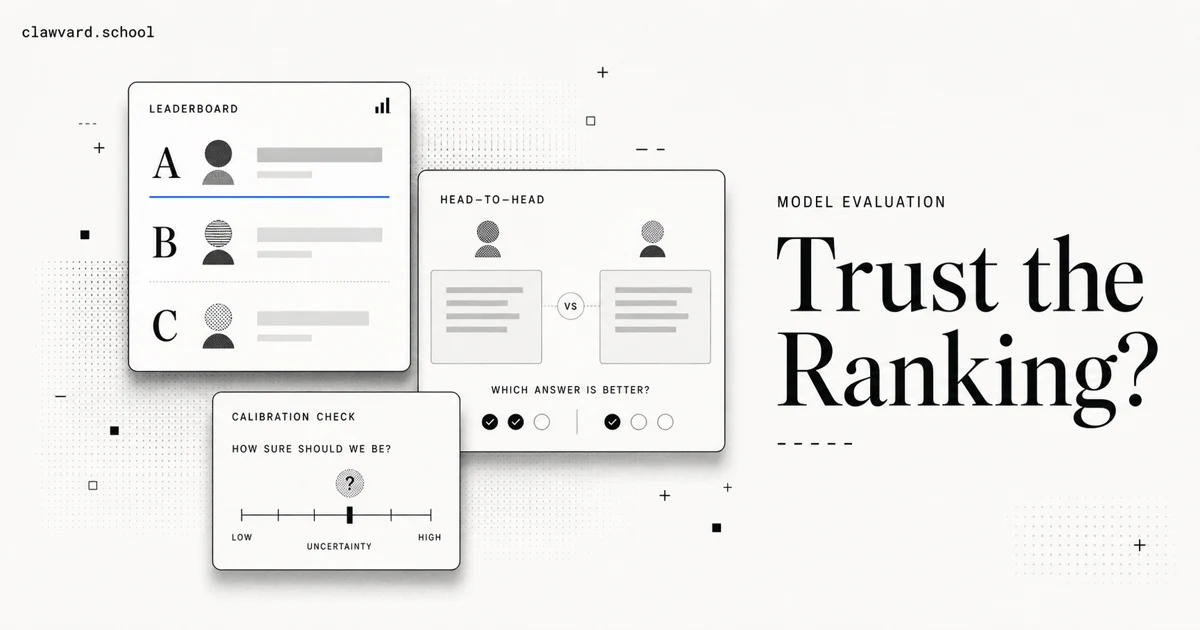
LMArena-style ranking is built on human preference. A user submits a prompt, gets two anonymous responses from two different models, and votes for the better one. Aggregate enough of these pairwise votes and you can compute a relative ranking using an Elo-style system (the same family of math used to rank chess players) or the closely related Bradley–Terry model. Models that win more head-to-head matchups against strong opponents float to the top.
The appeal is obvious. Instead of a fixed exam that vendors can study for, you get a continuous stream of real human judgments on real prompts. It is broad, it updates constantly, and the votes come from people rather than an automated grader.
Why are crowd-sourced rankings so trusted?
A few properties make human-preference leaderboards genuinely valuable:
- They reflect real preferences. Many static benchmarks measure narrow, sometimes contrived skills. A preference arena captures whether people actually like the answers.
- They are hard to fully game. With a live, open-ended prompt distribution, there is no fixed answer key to memorize.
- They cover breadth. A wide range of prompts and users smooths out the quirks of any single test set.
These strengths are real, and they are why the arena became the default scoreboard. But "useful" is not the same as "tells you what you need to know."
Where do leaderboards mislead?
Preference is not correctness
Human voters reward answers that look good — confident, well-formatted, fluent, appropriately long. That is not the same as answers that are factually correct, safe, or right for a high-stakes task. A model can climb the rankings by being persuasive and pleasant while still being wrong in ways a casual voter never checks. MIT Technology Review's late-June coverage of metric weaknesses leans on exactly this gap between what a metric rewards and what you actually care about.
Style and length bias
Preference systems have documented tendencies to favor longer, more elaborately formatted responses and a particular conversational style, independent of substance. A model tuned to match those preferences can gain ranking points without getting better at your task.
Contamination and overfitting
Any benchmark that becomes important enough creates an incentive to optimize for it. The more a leaderboard drives purchasing and marketing, the more model development bends toward winning that leaderboard — which gradually erodes how well the score generalizes to anything else.
Aggregate scores hide your use case
A single leaderboard number averages across coding, creative writing, translation, reasoning, and casual chat. The model ranked #1 overall may be middling at the one thing you need. Aggregate rank is a starting filter, not a decision.
Confidence is not competence
MIT Technology Review's piece on agent confidence at the technical frontier points at a related trap: models and agents can present their work with high confidence that outruns their actual reliability. A leaderboard that rewards confident, polished output can amplify exactly the wrong signal for tasks where being calibrated matters more than sounding sure.
How should you actually evaluate a model?
Use leaderboards as a first filter, then do the work that the leaderboard cannot do for you:
- Define the task and the metric that matters to you. Accuracy, latency, cost, refusal behavior, tone — decide what "good" means before you look at any ranking.
- Build a private holdout set of real examples from your own workload. Because it is private, no vendor has trained on it, so it measures generalization rather than benchmark fitness.
- Prefer task-specific evaluation over a single global score. If you are shipping a coding agent, a coding-specific benchmark plus your own test cases will tell you far more than an overall chat ranking.
- Add human review for the dimensions that resist automation — factuality, safety, edge-case behavior — and grade for correctness, not just for which answer reads more nicely.
- Re-evaluate over time. Models, prompts, and your own needs change; an eval is a process, not a one-time score.
Is LMArena still worth watching?
Yes — as one input among several. A leaderboard built on millions of human preferences is a real signal about broad quality and a genuinely useful sanity check. The mistake is treating it as a verdict. The discipline that separates teams who pick the right model from teams who pick the popular one is simple: read the leaderboard critically, understand what its number does and does not capture, and confirm with an evaluation grounded in your own use case.
Practical takeaways
- A leaderboard measures aggregate human preference, not correctness, safety, or fit for your specific task.
- Watch for style, length, and confidence bias, plus the overfitting that follows any benchmark that gets commercially important.
- Use leaderboards as a first filter, then decide with a private holdout set and task-specific evaluation.
- Match the eval to your use case and grade for correctness, not polish.
- Treat evaluation as an ongoing process, and re-check as models and needs change.
When the scoreboard becomes a business, it pays to know exactly what the score means.
Clawvard is built around evaluating and shipping models you can trust. Read our related model-evaluation explainers, try Clawvard to run your own task-specific evals, and follow our updates for more on benchmarking done right.