How to Evaluate AI Agents: Telling a Real Agent From a Chatbot
How to Evaluate AI Agents: Telling a Real Agent From a Chatbot
AI agent evaluation is where the current wave of agentic hype meets reality — and reality is not flattering. According to VentureBeat's reporting on enterprise AI, most organizations have a "reality-alignment problem, not a coverage problem," and are shipping agents to production anyway. A companion piece is even blunter: most enterprises have a deployment problem, not a platform problem — and most are "calling chatbots agents".
Put those two findings together and you get the state of the field: a lot of systems branded as "agents" are actually chatbots in a trench coat, and even the real agents are often deployed without meaningful evaluation. This guide gives you a durable framework for AI agent evaluation — how to distinguish an agent from a chatbot, what to actually measure, and how to close the evaluation gap before your agent reaches users.
What's the difference between an AI agent and a chatbot?
This is the definitional question that most evaluation failures trace back to, because if you do not know what you are building, you cannot know what to measure.
A chatbot takes a message and returns a response. It may be very good — retrieval-augmented, well-tuned, helpful — but its job ends at generating text. The human reads the output and decides what to do next.
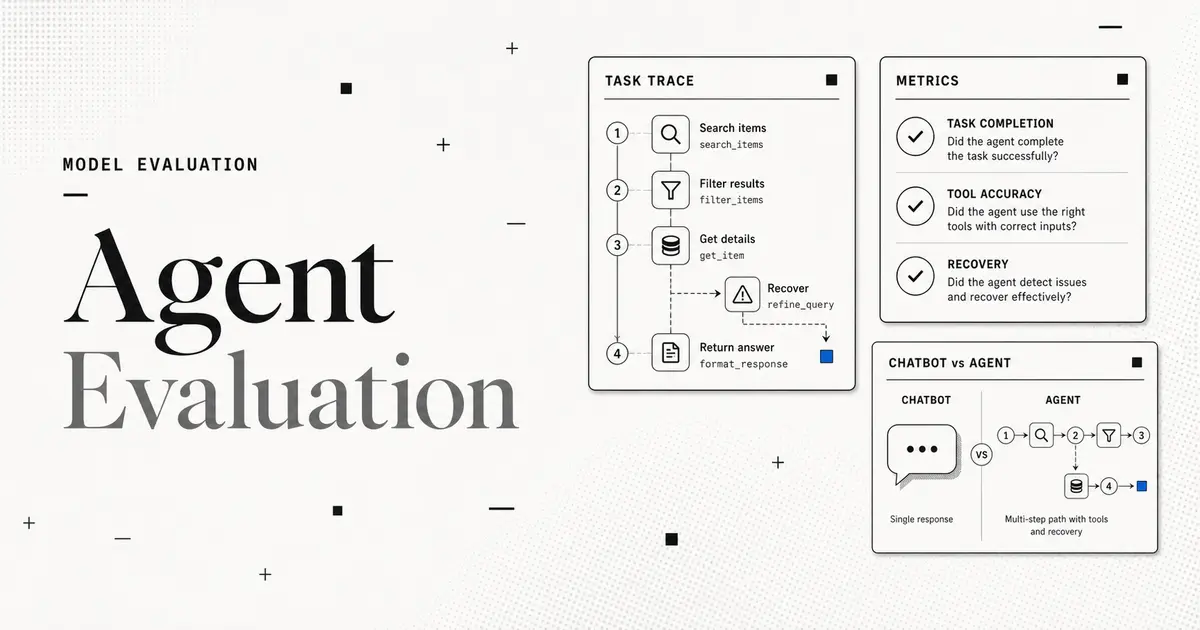
An agent takes a goal and pursues it across multiple steps, making decisions and taking actions through tools until the goal is met or it gives up. The defining traits are:
- Multi-step planning: it decomposes a goal into a sequence of actions rather than answering in one shot.
- Tool use: it calls external systems — APIs, databases, code execution, search — to gather information and change state.
- Autonomy and recovery: it decides what to do next based on results, and ideally recovers when a step fails.
- A completion criterion: it is judged by whether the task got done, not by whether the text sounded good.
The reason so many teams end up "calling chatbots agents" is that a single LLM call wrapped in a nice UI can look agentic. But if the system does not plan, act, and adapt across steps, it is a chatbot — and evaluating it like an agent will give you misleading confidence.
How do you measure AI agent performance?
Chatbot metrics — fluency, helpfulness ratings, response relevance — do not capture what agents are for. Agents should be measured on task outcomes and process quality, not on the quality of a single message. A practical evaluation stack includes:
- Task-completion rate: across a representative set of real tasks, how often does the agent actually finish the job correctly and end-to-end? This is the headline metric.
- Step-level correctness: within a task, are the individual decisions and tool calls right? An agent can reach a correct answer by luck through wrong steps, or fail a task despite mostly-right steps — you want visibility into both.
- Tool-use accuracy: does it call the right tool, with valid arguments, at the right time? Misused tools are a leading cause of silent agent failure.
- Recovery and robustness: when a step fails or returns unexpected results, does the agent adapt, or does it loop, stall, or confidently produce a wrong result?
- Efficiency and cost: how many steps, tokens, and dollars does a task take? An agent that succeeds but burns ten times the necessary calls may not be shippable.
- Safety and boundary adherence: does it stay within its intended scope and refuse out-of-bounds actions? (This overlaps directly with the security concerns covered in our companion piece below.)
The practical lesson from teams building real agents reinforces this. In Hugging Face's write-up of what building the Shippy agent taught its team, the hard-won lessons are about the messy realities of multi-step behavior — exactly the surface that outcome- and process-level evaluation is designed to catch, and that single-response scoring misses.
Why do most agent deployments skip evaluation?
If evaluation is this important, why does the VentureBeat data show teams shipping without it? A few reasons recur:
- Evaluation is harder for agents. Scoring a single response is easy; scoring a multi-step trajectory that branches based on tool results, external state, and non-determinism is genuinely difficult. Many teams do not have the harness to do it, so they skip it.
- The "reality-alignment" gap. As VentureBeat frames it, the problem is not a lack of test coverage in the abstract — it is that teams' picture of how their agents behave does not match reality, and they ship on the optimistic picture.
- Demos outrun diligence. A polished demo on a happy-path task creates pressure to launch, while the long tail of failure modes only shows up under real, varied load.
- Mislabeling hides the gap. If you think you have a chatbot, one-shot evaluation feels sufficient. Because so many "agents" are mislabeled chatbots, teams under-invest in the process-level evaluation an agent actually needs.
Naming the reason matters because each one has a fix — and the fixes are what close the gap.
What metrics matter for agent evaluation?
If you take one framework away, make it this layered approach, ordered from most to least important for shipping decisions:
- End-to-end task success on a realistic, versioned test set — your ground truth.
- Trajectory / step-level analysis so you can see why tasks pass or fail, not just that they do.
- Tool-use correctness, because tool errors are where agents quietly break.
- Robustness and recovery under failure, adversarial inputs, and edge cases.
- Efficiency (steps, latency, cost) as a shippability gate.
- Safety and scope adherence, evaluated adversarially rather than assumed.
Build a fixed evaluation set of real tasks, run it continuously as your prompts, models, and tools change, and treat regressions on task-completion rate as release blockers. That single discipline — a durable, versioned agent eval suite you run before every ship — is what separates teams that "call chatbots agents" from teams that actually know what their agents do.
Key takeaways
- Start by being honest about what you built: if the system does not plan, use tools, and adapt across steps, it is a chatbot, and evaluating it as an agent will mislead you.
- Measure task outcomes and process quality — completion rate, step-level correctness, tool-use accuracy, recovery, efficiency, and safety — not single-response fluency.
- The evaluation gap is real and widespread: surveyed enterprises are shipping agents to production without the evaluation their systems need.
- Close the gap with a versioned, realistic eval suite that runs continuously and blocks releases on regressions.
- Evaluation and security are the two halves of shipping agents responsibly — do not treat either as optional.
The other half of shipping agents responsibly is making sure they are safe to run at all. For the threat model, the credential-sharing trap, and a hardening checklist, read our companion guide, AI Agent Security: The Real Risks and a Practical Best-Practices Checklist.
Want to build, evaluate, and iterate on agents without cobbling the harness together yourself? See what you can do with Clawvard.