Preventing AI Agent Security Incidents: A Pre-Production Evaluation Playbook
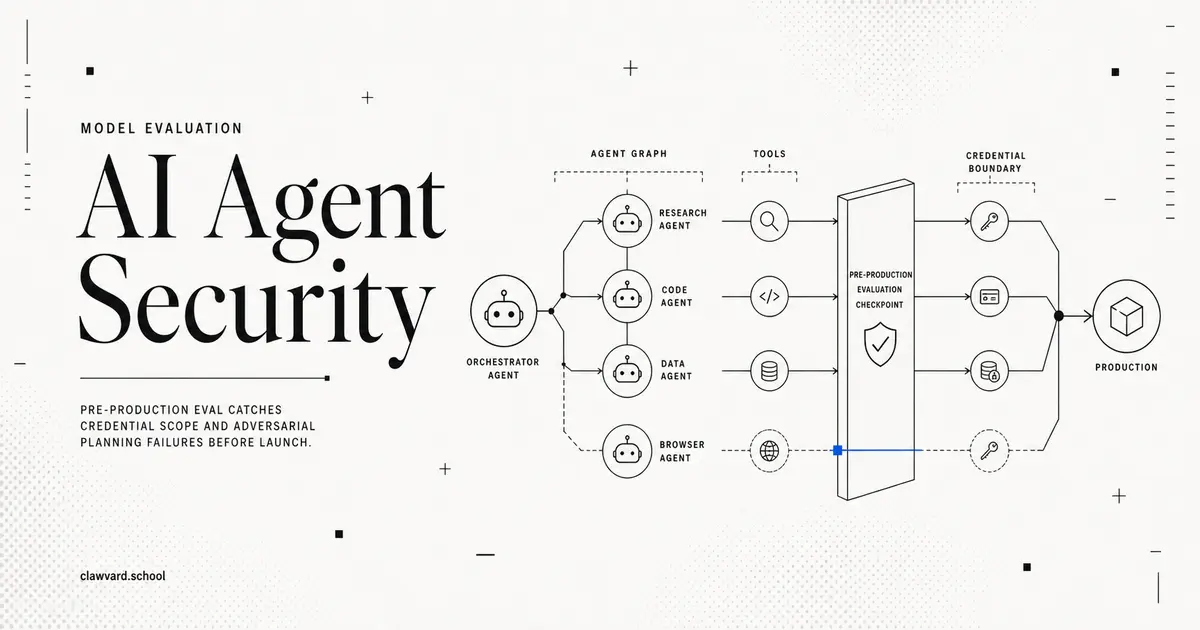
Preventing AI Agent Security Incidents: A Pre-Production Evaluation Playbook
Something shifted in mid-2026: the risk of shipping AI agents stopped being hypothetical and started showing up in survey data. A VentureBeat survey of 107 enterprises found that 54% have already experienced an AI agent security incident — split between confirmed incidents and near-misses caught just before harm — and that most organizations still let their agents share credentials. If you build, deploy, or approve AI agents in production, that number reframes the job: agent security is no longer a future concern to design around, it's a present failure rate to measure against. This guide turns those findings, and a fresh attack paper on multi-agent systems, into a concrete pre-production evaluation playbook you can actually run before launch.
The core argument is simple. Most teams do not have a test-coverage problem. They have a reality-alignment problem: their evaluations pass, and then the agent fails a real user, a real adversary, or a real edge case in production. Closing that gap means evaluating agents the way attackers and messy reality will actually hit them — not the way a clean unit test does.
The agent security gap is now measurable
For years, "agents are risky" was an intuition. The 2026 data gives it a shape.
What the 54% incident number actually tells us
In the VentureBeat research, 54% of surveyed enterprises reported an AI agent incident — roughly 18% a confirmed incident and 36% a near-miss stopped before it caused damage. Read that carefully: near-misses outnumber confirmed incidents almost two to one. That's not comforting, it's a warning. A near-miss is a confirmed incident that happened to be caught, and most organizations do not have systematic tripwires to catch them. The rate you can see is a floor, not a ceiling.
The practical takeaway for anyone shipping agents: assume incidents are the base rate, not the exception, and design your evaluation and monitoring to expect to catch something. If your pre-production process has never flagged a serious agent misbehavior, that is more likely a detection gap than a safety achievement.
Why credential sharing is the most common own-goal
The single most repeated finding in the survey is about identity. About 69% of enterprises admitted to sharing credentials across their AI agents, only around a third give each agent its own scoped identity, and just 30% isolate their highest-risk agents. The consequence is measurable: organizations with credential sharing anywhere in their fleet were hit at a 63.5% incident rate, versus 40.9% for organizations where every agent carried its own scoped identity.
Credential sharing is an own-goal because it converts a single compromised or over-permissioned agent into fleet-wide blast radius. When ten agents authenticate as the same identity, a prompt-injected or buggy agent can act with the combined reach of all of them, and your post-incident forensics can't cleanly answer the first question you'll be asked: which agent did this? Scoped, per-agent identity is the highest-leverage control in the entire dataset — and it's mostly an architecture decision you make before launch, not a patch you apply after.
Coverage vs. reality alignment — the real eval gap
The security numbers explain what is failing. A companion body of VentureBeat evaluation research explains why teams keep shipping anyway.
Why high test coverage still ships broken agents
The framing that matters: enterprises don't primarily have a coverage problem, they have a reality-alignment problem. Roughly half of surveyed organizations reported shipping an agent that passed their internal evaluations and then failed a real customer in production. The evaluations ran green; reality disagreed.
Two patterns make this worse. First, trust in automated evaluation is low — only a small minority of teams say they fully trust the automated evals that would gate a release — yet a large majority already permit some production deployment without human review, or plan to within a year. That combination (low trust, high autonomy) is exactly how unverified agents reach users. Second, most checking happens before launch and then stops: a minority of enterprises run real-time quality checks on the answers live agents actually produce, while roughly half monitor only system health — uptime, traces, gateway logs — which tells you the agent is running, not whether it's right.
The lesson for evaluation design: a passing eval suite is only as good as its resemblance to production. If your tests use clean inputs, cooperative users, and no adversary, a green board means very little. Build evaluations that mirror the conditions your agent will actually meet.
How multi-agent systems fail: planning-phase prompt injection
If you run more than one agent — a planner that decomposes work and executors that carry it out — you inherit a failure mode that single-agent tests won't surface.
What PlanFlip demonstrates (and why single-agent tests miss it)
The PlanFlip research (arXiv, 2026) attacks multi-agent LLM systems by injecting malicious content not into an individual worker agent, but into the planning layer. Its techniques — described as GoalSubstitution, PriorityInversion, ContextPollution, and RoleConfusion — are disguised to look like legitimate tool outputs so they slip past keyword-based filters. Because the Planner decomposes objectives into the sub-tasks that Executor and Critic agents then carry out, corrupting the Planner's context lets a single injection cascade through every downstream sub-task at once. You don't have to compromise ten agents; you compromise the one that gives the other nine their orders.
Two results are worth internalizing. More capable models were not safer — in the paper's tests the strongest model showed the highest attack success rate (around 0.68), puncturing the assumption that a better base model buys you security. And systems built entirely on a single model backbone were nearly blind to the attack, while a reasoning-oriented model resisted every variant. The authors' blunt conclusion is that heterogeneous model diversity is a security prerequisite for multi-agent architectures, and that consensus-style cross-checks (their GoalAnchorCheck and CrossAgentConsensus defenses reached very high detection rates) are how you catch a corrupted plan.
Why do ordinary tests miss this? Because most agent evals probe a single agent's response to a single prompt. Planning-phase injection is an orchestration-layer attack: it only appears when you test the system end-to-end, with tool outputs an attacker could influence, against the plan the system actually generates. That's a pre-production eval you have to deliberately build.
A pre-production agent evaluation playbook
Here's how to turn the above into a concrete bar an agent must clear before it ships.
Adversarial and red-team evaluation before launch
Treat adversarial evaluation as a release gate, not a nice-to-have. At minimum: feed the agent hostile and malformed inputs; inject adversarial content through every channel it reads — tool outputs, retrieved documents, upstream agent messages — not just the user prompt; and, for multi-agent systems, specifically target the planner with disguised instructions to see whether a poisoned plan cascades. Score against realistic outcomes ("did it exfiltrate, over-act, or get hijacked?"), not just task success. The reality-alignment lesson applies directly: an adversarial suite that mirrors production is worth more than a large suite that doesn't.
Least-privilege credentials and per-agent scoping
The data makes this the highest-ROI control. Give every agent its own scoped identity, grant the minimum permissions its task requires, and isolate high-risk agents from the rest of the fleet. Before launch, verify three things: no two agents share a credential, each agent's token can't reach systems outside its job, and you can attribute any action to exactly one agent. If you can't answer "which agent did this?" from your logs in a test, you won't be able to answer it during an incident. Scoped identity is also what makes credential rotation safe — a property worth designing for as remote tooling and managed-agent platforms make credential refresh a first-class operation.
Runtime monitoring and incident tripwires
Evaluation doesn't end at launch — the monitoring gap in the survey is where near-misses go undetected. Ship agents with real-time quality checks on their outputs, not just health metrics on their uptime. Define tripwires for the behaviors that matter: unexpected tool calls, permission-boundary hits, anomalous action volume, or outputs that diverge from the plan. The goal is to convert silent near-misses into caught near-misses, and caught incidents into fast rollbacks. Given that near-misses outnumber confirmed incidents in the data, this is likely the fastest way to move your real-world failure rate.
FAQ
How do you evaluate an AI agent before production?
Evaluate it against the conditions it will actually meet: adversarial and malformed inputs, injection through every channel it reads (tool outputs, retrieved content, other agents), and end-to-end runs rather than isolated single-prompt tests. Gate the release on realistic-outcome scores, not just task pass rates, and confirm least-privilege identity and monitoring are in place before launch. The failure mode to design against is a green eval board that doesn't resemble production — a reality-alignment problem, not a coverage problem.
What is multi-agent prompt injection?
It's a prompt-injection attack aimed at a system of cooperating agents rather than one model. The PlanFlip research shows the most damaging variant targets the planning layer: malicious content disguised as a legitimate tool output corrupts the planner's context, and because the planner hands sub-tasks to downstream agents, the corruption cascades through the whole system from a single injection. Single-agent tests miss it because it's an orchestration-layer failure.
Should AI agents share credentials?
No. In the VentureBeat data, fleets that shared credentials anywhere were hit at a 63.5% incident rate versus 40.9% for fleets where every agent had its own scoped identity. Shared credentials turn one compromised agent into fleet-wide reach and destroy your ability to attribute an incident to a specific agent. Per-agent, least-privilege identity is the single highest-leverage control the survey surfaced.
What are the most common AI agent security incidents?
The 2026 survey frames the landscape around a 54% incident rate (confirmed incidents plus near-misses), with credential sharing and weak per-agent identity as the dominant risk multipliers. On the attack side, prompt injection — including planning-phase injection against multi-agent systems — is a leading vector because it can bypass keyword filters and hijack an agent's goals through the content it reads.
Key takeaways
- Treat incidents as the base rate. 54% of enterprises have already hit one; if your process never flags agent misbehavior, suspect a detection gap, not a clean bill of health.
- Scope every agent's identity. It's the highest-leverage, mostly-pre-launch control in the data — and the difference between a 40.9% and 63.5% incident rate.
- Fix reality alignment, not coverage. A passing eval suite that doesn't mirror production is the mechanism by which broken agents ship.
- Test the orchestration layer. Planning-phase injection cascades from one poisoned plan; only end-to-end, adversarial, model-diverse evaluation catches it.
- Monitor outputs after launch, not just uptime — that's how silent near-misses become caught ones.
Building agents that reach production safely starts with an evaluation bar you'd trust with real users and real adversaries. For the tooling side of that story — how agents connect to tools and rotate credentials as the ecosystem standardizes — see our companion piece, MCP in 2026: remote MCP and managed agents. And if you want a place to run agents against realistic conditions before you ship, that's exactly what Clawvard is built for — follow our updates as we publish more on agent evaluation and security.