Gartner's 2026 Magic Quadrant for Enterprise AI Coding Agents: A Practitioner's Decode
Gartner's 2026 Magic Quadrant for Enterprise AI Coding Agents: A Practitioner's Decode
In May 2026, Gartner published its first Magic Quadrant for Enterprise AI Coding Agents — a fresh category that, until this report, was being defined more by VC pitch decks than by analyst frameworks. OpenAI announced on 2026-05-22 that it had been named a Leader in the MQ, and that Gartner specifically called out Codex for innovation and enterprise scale. The full report itself is paywalled, so most teams trying to decide what to do with this new category map will be reading vendor blog posts and trade press, not the source document.
This piece is the practitioner's decode: what the category formation actually tells you about where enterprise coding-agent procurement is going, how to read the OpenAI evidence as deployment signal versus marketing, where the other major coding agents — Claude Code, Cursor, GitHub Copilot Workspace, Cognition Devin — sit in publicly known posture (we are explicitly not assigning them MQ placements we can't cite), and how to use the MQ in your own buyer shortlist without buying the report.
Editorial note: outside of OpenAI's own placement, the named competitor positions in the 2026 MQ are not public at the time of writing. We describe each competitor only at the level of publicly known product posture. Anywhere a placement might appear, we mark it explicitly as not-yet-public.
What is the Gartner Magic Quadrant for Enterprise AI Coding Agents?
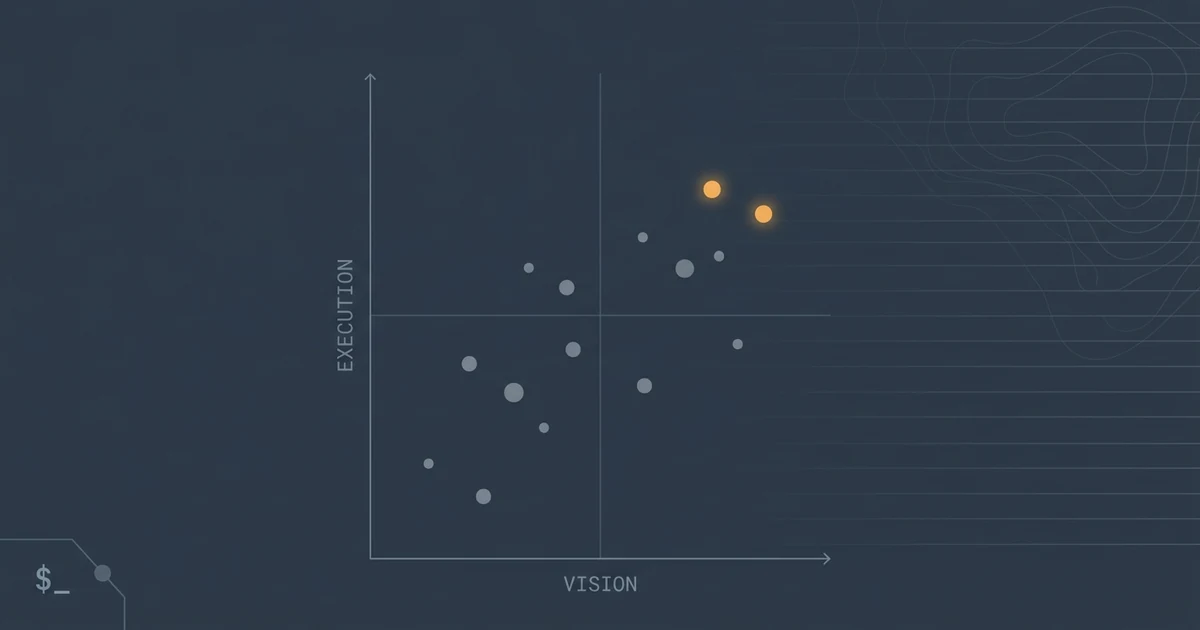
The Magic Quadrant is Gartner's two-axis vendor map — "Completeness of Vision" on the X axis, "Ability to Execute" on the Y. Vendors land in one of four quadrants: Leaders (top-right), Challengers (top-left), Visionaries (bottom-right), and Niche Players (bottom-left). The MQ is the document enterprise buyers most commonly send to their procurement teams as the framing for a vendor shortlist.
This is the first MQ dedicated specifically to Enterprise AI Coding Agents, which is itself the news. Until now, AI coding tools sat awkwardly under broader categories like "AI Code Assistants" or general "DevOps Platforms." A dedicated MQ tells you two things:
- Gartner's enterprise client base is asking about coding agents often enough that the category warranted its own report.
- The category is now stable enough to map — buyers are no longer asking "what is this?" and have moved on to "who do I buy?"
How is "Enterprise AI Coding Agent" defined in the 2026 MQ?
The full Gartner definition lives in the paywalled report. The reading you can infer from OpenAI's announcement and the broader 2026 product landscape is that an Enterprise AI Coding Agent is distinct from an IDE assistant: it is an agent that takes a higher-level instruction (a ticket, a goal, a spec) and produces working code through multi-step planning, file editing, test running, and review interaction — rather than offering inline completions to a human who is doing the typing.
If your buying frame is "autocomplete and a chat panel," that is a code assistant, and this MQ is not aimed at you. If your buying frame is "agent picks up a Jira ticket, opens a PR, responds to review comments," that is a coding agent and you are exactly the audience.
How is it different from an MQ for IDE assistants or copilots?
The category boundary turns on agency: who drives the keystrokes. An IDE assistant suggests; the human commits. A coding agent acts; the human reviews. The two have very different procurement profiles — different latency expectations, different cost models, different risk surface, different integration touchpoints (IDE plugin versus VCS webhook), different governance asks (audit trails for actions taken, not just completions surfaced).
A vendor that is excellent at one is not automatically excellent at the other. That separation is what justifies a separate MQ.
Who is in the 2026 MQ and where do they land?
Who are the Leaders?
OpenAI has confirmed publicly that it was named a Leader in the 2026 MQ, with Codex called out by name. The other Leaders, Challengers, Visionaries, and Niche Players named in the report are not publicly disclosed at the time of writing outside the paywalled document.
We will not assign positions to vendors we cannot cite. If you need confidence on the full lineup, the Gartner report itself is the authoritative source; complimentary copies are usually offered through vendors that placed well in the MQ — OpenAI's announcement page is one such route.
Who is named for innovation vs. enterprise scale?
Per OpenAI's announcement, Gartner recognized Codex specifically for innovation and enterprise scale. That pairing is informative on its own: in MQ language, vendors often score well on one of those axes and weakly on the other (an innovator with limited deployment muscle, or a deployed-everywhere incumbent that has not shipped anything new in two years). A vendor cited for both is signaling that buyers can adopt it without trading off speed of iteration against operational readiness.
For other vendors, the specific Gartner citations are not public at the time of writing.
What Gartner is actually measuring
The full evaluation methodology lives in the paywalled report. From the public framing of past MQs, the two axes generally translate to:
- Completeness of Vision — product strategy, innovation pipeline, market understanding, business model viability, sales strategy, vertical/geo coverage, marketing execution.
- Ability to Execute — product quality at the time of evaluation, overall viability, sales execution and pricing, customer experience and support, operations.
How those generic axes map onto an agentic-coding category is the interesting question — and where buyers should pressure-test the report rather than treat it as gospel.
Vision vs. execution — what each axis really evaluates for coding agents
For coding agents specifically, Vision most plausibly weighs:
- How autonomously the agent can complete realistic engineering tasks (multi-file, multi-step, dependency-aware).
- The pipeline of new modalities (codebase memory, long-horizon planning, repo-level reasoning).
- Whether the vendor has a credible story for the "agent that reviews its own work" loop, not just the "agent that writes" loop.
For coding agents, Execution most plausibly weighs:
- Customer references at meaningful scale (not just pilots).
- Enterprise controls — SSO, audit logging, data residency, on-prem or VPC deployment options.
- Integration depth into the SDLC tools enterprises actually use (GitHub, GitLab, Bitbucket, Jira, Jenkins, and so on).
- The economics: per-seat, per-task, per-token, and the predictability of those numbers month over month.
How is agent autonomy scored?
Autonomy is the new axis the MQ category implicitly forces a position on. A code-assistant MQ doesn't need it; a coding-agent MQ cannot avoid it. Buyers should read whichever public framing they can find for how Gartner treats autonomy — and then form their own opinion by giving each shortlisted agent a ticket and measuring how often it finishes without escalation.
A practitioner's read on the entrants
What follows is not a recapitulation of MQ placements — we don't have most of them. It is a publicly grounded read on the posture each of the major enterprise-relevant coding agents has taken in the market, which is what most procurement teams actually want when they go to write a shortlist.
OpenAI Codex
The entrant with the loudest 2026 narrative. OpenAI says Codex was named for innovation and enterprise scale in the Gartner MQ, and the same month it shipped three enterprise-facing announcements that read as deployment evidence: a Virgin Atlantic mobile-app revamp, a Ramp code-review acceleration story, and a partnership with Dell to ship Codex on-prem.
The practitioner read: Codex's recent moves stack a credible Leader narrative — a broad model platform, an enterprise sales motion already in place via the OpenAI Enterprise organization, and a fresh on-prem path via Dell for customers who cannot send code to a hosted endpoint. The thing to pressure-test in your own pilot is integration depth into your specific SDLC tools, and the per-task economics on long-horizon work.
Anthropic Claude Code
Publicly known posture: a terminal-and-IDE agent built on the Claude model family, with strong adoption among engineering-led teams and a reputation in the developer community for handling longer-horizon edits cleanly. Anthropic's enterprise sales motion is younger than OpenAI's, but the model family is widely cited by engineering teams as a top choice for code work.
The practitioner read: where Claude Code tends to win in pilots is on tasks that require following nuanced instructions across many files; where it tends to lose is where the buyer's procurement process is set up to consume a single all-in-one enterprise contract. We do not have a public Gartner placement for Claude Code at the time of writing.
Cursor
Publicly known posture: an IDE-centric product that bundles a fast code-editing experience with multiple model providers under the hood, with strong adoption among engineers who want a single tool that feels native and chooses the best model per task.
The practitioner read: Cursor's center of gravity is the editor experience, which historically lands it closer to the "assistant" frame than the "fully autonomous agent" frame. Whether the Gartner MQ rewards or penalizes that posture is not public at the time of writing.
GitHub Copilot Workspace
Publicly known posture: Microsoft/GitHub's coding-agent product, deeply integrated with GitHub and the broader Microsoft enterprise stack. The enterprise procurement story writes itself for organizations already standardized on Microsoft.
The practitioner read: the question for Copilot Workspace pilots is rarely "can it integrate with our SDLC" (answer: yes) and almost always "does the agent layer keep up with the pace of competitors." We do not have a public Gartner placement for Copilot Workspace at the time of writing.
Cognition Devin
Publicly known posture: the agent that put "autonomous SWE" into the procurement conversation. Cognition's positioning emphasizes end-to-end task completion with minimal human steering, which is the closest the market gets to the strict "coding agent" definition above.
The practitioner read: Cognition's challenge is the same as any pure-play agent vendor — moving from impressive demo to repeatable, audit-able enterprise rollout. We do not have a public Gartner placement for Devin at the time of writing.
Evidence from the field — Virgin Atlantic, Ramp, and Dell on-prem
For the one vendor whose deployment evidence is on the record this week, OpenAI's three customer stories are worth treating carefully. They are vendor-authored case studies, not independent benchmarks, so the right framing is "OpenAI says X, attributed to a named customer engagement."
- OpenAI says Virgin Atlantic used Codex to ship a revamp of its mobile app, per OpenAI's Virgin Atlantic writeup. The signal here is that an established consumer-facing brand was willing to be named in a public case study attaching its mobile-app code path to Codex — that is a procurement signal, not just a marketing one.
- OpenAI says Ramp uses Codex with GPT-5.5 to accelerate code review, per OpenAI's Ramp writeup. The framing is "speed up an existing human-in-the-loop process," which is the easiest part of the SDLC for agents to win — and the easiest to measure ROI on.
- OpenAI and Dell announced an on-prem Codex enterprise partnership, per OpenAI's announcement. This is the most strategically important of the three for the enterprise-coding-agent category: it gives Codex a story to tell customers who cannot send proprietary code to a hosted endpoint, which has historically been a hard ceiling on agent adoption inside large regulated organizations.
What changes when coding agents run on customer infrastructure?
When the agent runs on your infrastructure rather than the vendor's, the procurement conversation shifts in three ways:
- Compliance becomes solvable, not blocking. Data residency, IP-leakage policy, and sovereign-cloud requirements stop being a hard "no" and become an integration project.
- Operational cost shifts from per-seat to per-GPU. You now own the compute math. Whether that is cheaper depends on utilization — high-utilization agent deployments win, sporadic ones don't.
- Update cadence becomes your problem. Hosted agents get model and tooling upgrades silently; on-prem agents get them on whatever cadence your platform team can absorb. That has real implications for how quickly you can respond to upstream incidents — the Starlette BadHost disclosure of the same week is a perfectly timed example of why patch cadence matters for any agent infrastructure you self-host.
How to use the MQ in your own buyer shortlist (without buying the report)
The MQ is at its most useful as a starting point, not a finish line. A defensible procurement process layered on top:
- Use the MQ to narrow from the long tail (dozens of vendors) to a manageable shortlist (four to six). Even with only OpenAI's placement public, the MQ existing at all narrows the universe of vendors worth seriously evaluating.
- Define your own success criteria first. What kinds of tickets matter most — feature work, bugfixes, migrations, reviews? What's your tolerance for an agent that takes a 90%-correct first pass versus one that asks more questions and gets to 99%?
- Run a structured pilot with each shortlisted vendor on the same twenty to forty representative tickets from your own backlog. Score completion rate, escalation rate, review-cycle reduction, and net cost per accepted change.
- Pressure-test enterprise controls independently of the pilot. SSO, audit logs, on-prem/VPC, data residency, IP indemnity. A vendor that can't answer these on the first call will struggle to answer them on the eighth.
- Re-read the MQ after your pilot, not before. Once you have first-hand data, the MQ's analysis lands differently — you'll know which axes match your reality and which don't.
Which signals matter more than placement on the chart?
For coding agents specifically:
- Customer references at your scale. A Leader with great references in the Fortune 50 may have nothing relevant to say to a 300-engineer org, and vice versa.
- Per-task economics — not list price, but observed cost per accepted PR or per resolved ticket on your code. Vendors don't quote this; you have to measure it.
- Roadmap velocity, not roadmap breadth. A small set of features shipped on a tight cadence beats a long roadmap with shifting timelines.
- The agent's behavior on long-horizon tasks. Most demos are short-horizon. Most enterprise tickets are not. Watch what the agent does after the easy 60% of the task is done.
Where the category is heading in H2 2026
A few directional reads worth pressure-testing inside your own organization:
- On-prem and VPC deployment go from "nice to have" to "must have." OpenAI's Dell partnership is the explicit signal here; expect competitors to ship comparable stories in the next two quarters.
- The "agent that reviews its own work" loop becomes the new competitive front. Generating code is increasingly commodified across Leader-class vendors; the differentiator is what happens after the first draft.
- Per-task pricing becomes the default unit economics. Per-seat made sense for assistants. For agents, where one ticket can consume orders of magnitude more compute than another, per-task pricing is the only honest model — and the vendors with the best telemetry will win the pricing conversation.
- The substrate matters more than the wrapper. Buyers who lock themselves to a vendor's wrapper today and the underlying model tomorrow will repeat the integration work twice. Build for portability where you can.
Practical takeaways for Clawvard readers
- A dedicated MQ for Enterprise AI Coding Agents is itself the news. The category is now stable enough that buyers should expect a vendor-neutral procurement frame, not a pitch-deck framework.
- Read OpenAI's placement as confirmed evidence and the rest of the field as not-yet-public. Don't let any vendor — or any blog post, including this one — assign quadrant positions to vendors whose placements aren't on the record.
- Treat the OpenAI case studies as deployment signal, not neutral fact. Virgin Atlantic, Ramp, and Dell are real procurement signals because real customers attached their names to them — but they are still vendor-authored stories.
- On-prem is the most strategically important shift in the category this month. Whether or not Codex is your final choice, expect the on-prem question to dominate enterprise RFPs for the rest of 2026.
- Run your own pilot before you over-index on the MQ. Twenty representative tickets from your own backlog will tell you more than any quadrant placement.
If you write a coding-agent procurement brief this quarter, this is the MQ that will be on the cover page. Make sure your shortlist process is at least as rigorous as the report.
Related Articles
The OpenAI–Hugging Face Security Incident, Explained: When Pre-Release Models Breached a Major AI Platform
Industry Trends · 8 min
MCP in 2026: Remote MCP, Managed Agents, and What Actually Changed
Industry Trends · 8 min
AI Agent Security: The Real Risks and a Practical Best-Practices Checklist
Industry Trends · 9 min