DiffusionGemma Explained: How Google's Open Diffusion LM Runs Up to 4x Faster Locally
DiffusionGemma Explained: How Google's Open Diffusion LM Runs Up to 4x Faster Locally
Google DeepMind has released DiffusionGemma, an open language model that swaps the usual word-by-word generation approach for a diffusion-based one — and the headline claim is a roughly 4x speed boost when running locally compared with the autoregressive Gemma line. The release was reported by Ars Technica and independently noted by Simon Willison on June 10, 2026. If you build on-device or latency-sensitive applications, DiffusionGemma matters because it attacks the single biggest bottleneck in local inference — how fast tokens come out — by changing the generation mechanism itself rather than just shrinking the model.
This explainer breaks down what DiffusionGemma is, why a diffusion approach can be faster, what the 4x figure actually represents, and how to decide whether it belongs in your stack.
What is DiffusionGemma?
DiffusionGemma is an open model in Google's Gemma family that generates text using a diffusion process instead of the standard autoregressive one. "Open" here means the weights are available to download and run yourself, in keeping with how the Gemma line has been distributed. The pitch, per the reporting above, is that you get output quality in the Gemma neighborhood while generating substantially faster on local hardware.
The reason that framing is interesting: most efforts to make local LLMs faster work by making the model smaller (quantization, distillation, pruning), which trades away some quality. DiffusionGemma instead changes how generation happens, aiming for the speedup without the usual size-for-quality tradeoff.
How does diffusion generation differ from autoregressive LLMs?
A standard large language model is autoregressive: it produces one token, feeds that token back in, produces the next, and repeats. Every token waits for the one before it. That strict left-to-right dependency is what makes generation feel sequential — and it's why long outputs take proportionally long to produce on local hardware.
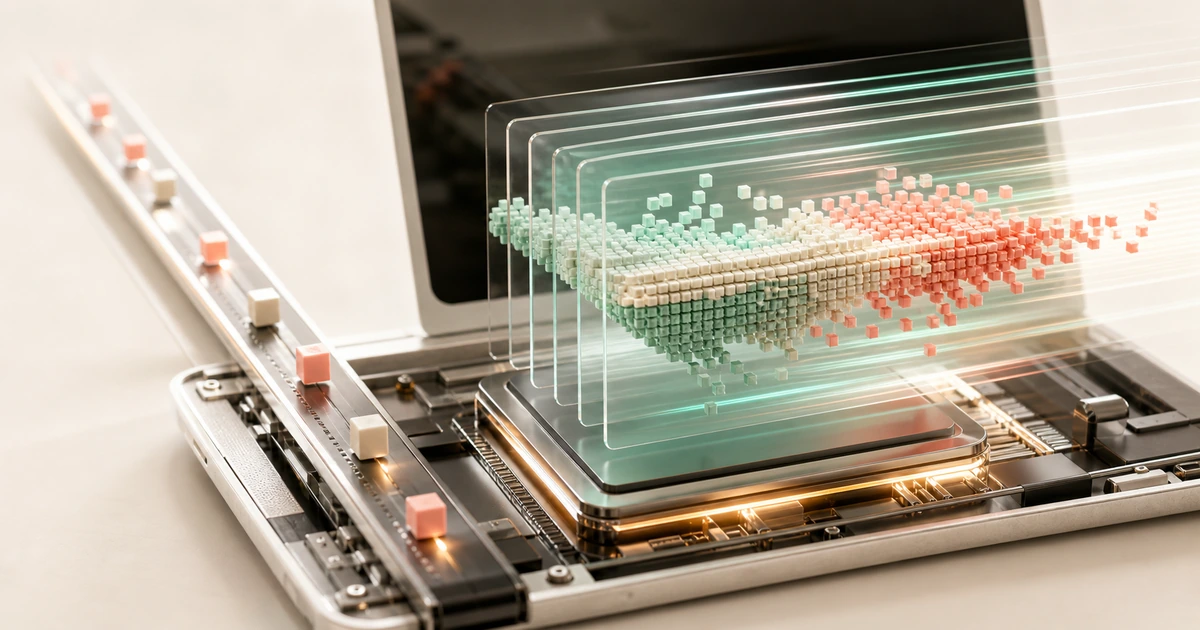
A diffusion language model works differently. Borrowing the idea that made diffusion dominant in image generation, it starts from a noisy or masked version of the whole output and refines many positions in parallel over a series of denoising steps, gradually resolving the sequence into coherent text. The key consequence is that generation is no longer strictly one-token-at-a-time; multiple positions can be filled in together, which is where the headroom for a speedup comes from.
That's the categorical difference. DiffusionGemma applies this parallel-refinement style of generation to an open Gemma-class model.
Where does the 4x speedup come from?
The roughly 4x figure reported by Ars Technica and echoed by Simon Willison traces back to that parallelism. When a model can resolve several token positions per step instead of emitting exactly one token per forward pass, it needs far fewer sequential steps to produce the same amount of text. On local hardware — where you're often memory-bandwidth bound and don't have a data-center batch of requests to hide latency — cutting the number of sequential steps translates fairly directly into lower wall-clock latency.
In short: autoregressive models pay a per-token sequential cost; diffusion generation amortizes that cost across parallel refinement steps. That's the mechanism behind the "4x faster locally" claim.
DiffusionGemma vs Gemma: what do the numbers mean?
The clean way to read the comparison is same family, different generation strategy. Standard Gemma is autoregressive; DiffusionGemma is diffusion-based. The reported advantage is speed on local inference, framed as about 4x.
Benchmark caveats
Treat the 4x as a reported, headline figure rather than a universal guarantee:
- Workload matters. Speedups on local, single-stream inference don't always carry over to server-side batched serving, where autoregressive models already hide latency across many concurrent requests.
- Conditions matter. Exact hardware, sequence length, sampling settings, and the number of diffusion refinement steps all move the real-world number. A single multiplier is a summary, not a spec.
- Speed is not quality. A faster generation method is only useful if output quality holds up for your task. Validate on your own prompts before trusting the headline.
The honest takeaway: 4x is a credible, well-sourced claim about the direction and rough magnitude of the improvement — verify the exact figure against your workload.
How do you run DiffusionGemma locally?
Because DiffusionGemma is an open model in the Gemma family, the practical path is the same one Gemma users already know: download the weights from the official distribution channel and run them through a runtime that supports the model. The important nuance is that diffusion generation is a different inference path than autoregressive decoding, so your local runtime or serving stack needs to actually support diffusion-style sampling to realize the speedup — a tool that only knows how to do token-by-token decoding won't unlock it.
What about hardware requirements?
The reporting frames DiffusionGemma as a local/on-device play, which is the whole point of the speed story. As a practical rule for any open Gemma-class model, your usable context length and throughput will track your available memory and accelerator. Confirm the specific size variants, supported runtimes, and minimum hardware against Google's official model card before committing — those details should come from the source of truth, not estimated.
When should you actually use DiffusionGemma?
DiffusionGemma is most compelling when local latency is your bottleneck: on-device assistants, privacy-sensitive deployments that can't call a cloud API, interactive tools where users feel every second of generation, or edge scenarios with no batching to amortize cost. In those settings, a generation method that needs fewer sequential steps is a structural win.
It's less obviously a win if you're already serving at scale in the cloud with high concurrency, where autoregressive batching is efficient — or if your task is quality-critical and you haven't yet validated that diffusion output meets your bar. As always, prototype against your real prompts before migrating anything.
FAQ
Is DiffusionGemma really 4x faster?
About 4x faster on local inference is the figure reported by Ars Technica and independently noted by Simon Willison. It's a credible directional claim, but the exact multiplier depends on hardware, sequence length, and sampling settings — benchmark it on your own workload rather than assuming a flat 4x everywhere.
Can it run on a laptop or local GPU?
DiffusionGemma is positioned as a local/on-device model, which is the basis of the speed story. Whether a specific laptop or GPU is enough depends on the size variant and your available memory — check the official model card for exact requirements rather than relying on a rule of thumb.
How does DiffusionGemma compare to standard Gemma?
Same model family, different generation strategy: standard Gemma is autoregressive (one token at a time), while DiffusionGemma uses diffusion to refine many positions in parallel. The reported difference is speed on local inference; validate quality for your own task before switching.
Is DiffusionGemma open source?
It's described as an open model in the Gemma family, meaning the weights are available to download and run yourself, consistent with how Gemma has been distributed. Confirm the exact license terms on the official model card.
Takeaways for Clawvard readers
- DiffusionGemma's speedup comes from changing the generation mechanism (diffusion, parallel refinement), not from shrinking the model — so the usual size-for-quality tradeoff doesn't apply the same way.
- The reported ~4x is a local-inference figure; it's strongest where you can't batch and weakest as a blanket promise. Benchmark before you trust it.
- Adopt it when local latency is the real constraint; validate output quality on your own prompts first.
If you're evaluating models for local or agent workloads, see our related coverage on running LLMs locally and on-device and how we approach model benchmarking and evaluation. Want hands-on help wiring fast local models into an agent workflow? Try Clawvard and follow our updates as we test DiffusionGemma in real pipelines.