How to Evaluate AI Agents: A Practical Reliability Playbook
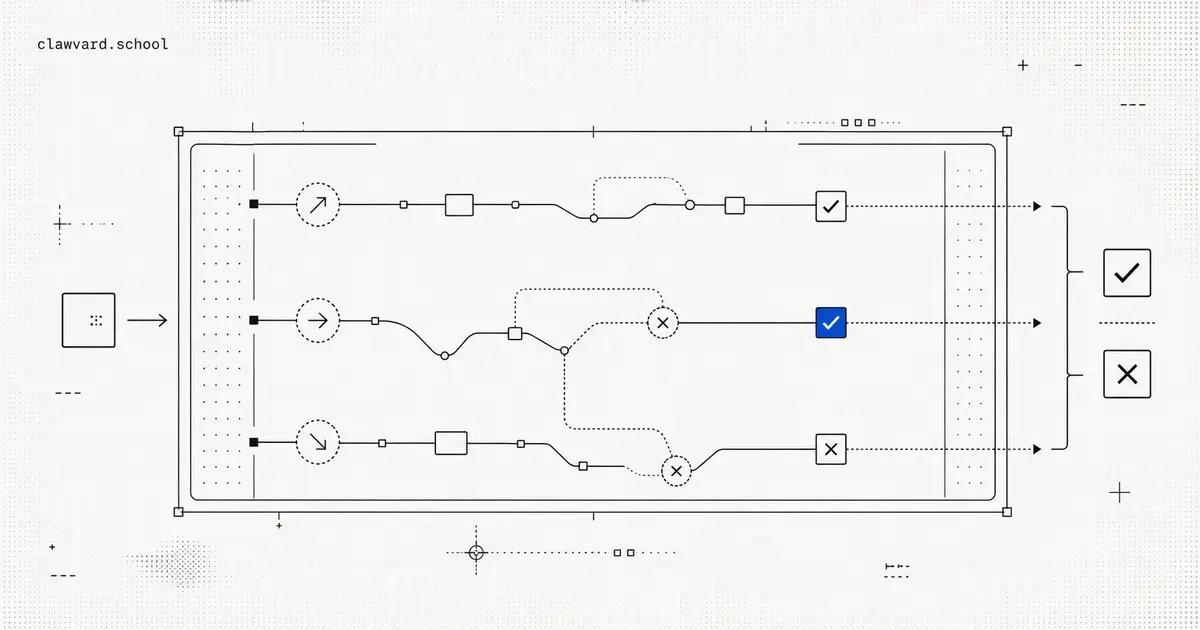
How to Evaluate AI Agents: A Practical Reliability Playbook
Most teams still ship AI agents on vibes. They run a few prompts by hand, watch the agent complete a happy-path task, and call it production-ready. Then the agent meets the real world — ambiguous requests, stale memory, a tool that returns an error it has never seen — and quietly fails in ways nobody measured. AI agent evaluation is the discipline that closes that gap, and in mid-2026 it stopped being optional. This guide lays out how to evaluate AI agents for correctness, reliability, memory, and failure modes, so you can catch regressions before your users do.
The signal that evaluation has gone mainstream is the money and research flowing into it. In June 2026, Patronus AI raised $50M to build "digital worlds" that stress-test AI agents (TechCrunch), and the same week brought new academic benchmarks targeting two of the hardest agent failure modes: knowing when to ask for clarification (DiscoBench) and keeping memory up to date over long tasks (Supersede). When a category attracts both venture funding and fresh benchmarks in a single week, it's a sign the practice is maturing — and that the teams without an evaluation story are now the outliers.
Why is AI agent evaluation suddenly a priority?
A chatbot answers one turn and you can eyeball whether it was good. An agent plans, calls tools, updates its own state, and runs for minutes or hours toward a goal. That autonomy is exactly what makes agents valuable — and exactly what makes them hard to trust. A single wrong tool call early in a long run can cascade into a confidently wrong final answer.
As agents move from demos into real workflows, the cost of an unmeasured failure rises. The funding and benchmarks above reflect a market realizing that "it worked when I tried it" does not scale to thousands of users with messy inputs. AI agent evaluation is how you convert that hope into a measurable, repeatable signal.
What makes evaluating AI agents harder than testing models?
Testing a base model is mostly about input → output quality. Evaluating an agent adds several moving parts that a model benchmark never touches:
- Multi-step trajectories. Success depends on the whole path, not just the last token. The agent can reach a correct answer through a broken process that won't generalize.
- Tool use. Agents call APIs, search, run code. Each tool is a new surface for errors, timeouts, and malformed outputs.
- State and memory. Long-running agents accumulate context, and stale or wrong memory is a distinct failure mode from a bad single response.
- Non-determinism. The same prompt can produce different trajectories on different runs, so a single pass tells you almost nothing about reliability.
That last point is the crux: agent evaluation is fundamentally about distributions of behavior, not one-shot correctness.
What should an AI agent evaluation cover?
A useful evaluation suite measures several dimensions, not just "did it get the right answer."
Task success and correctness
Define what a correct outcome looks like for each task, then score against it. Prefer checkable end states (a file written, a record updated, a value computed) over fuzzy judgments where you can. Where you can't, use a rubric and, optionally, an LLM-as-judge with a clearly defined standard.
Reliability and consistency across runs
Run each scenario many times and look at the pass rate, not a single result. An agent that succeeds 60% of the time looks fine in a one-off demo and is a liability in production. Tracking pass-rate distributions is how you turn reliability from a feeling into a number.
Memory and state over long horizons
Long tasks expose whether an agent keeps its internal picture current as facts change. This is the gap the Supersede research targets — diagnosing and training the "memory-update gap" in LLM agents (arXiv). Build evals where a fact changes mid-task and verify the agent acts on the new value, not the stale one.
Knowing when to ask
A capable agent should ask for clarification when a request is genuinely ambiguous instead of charging ahead on a guess. DiscoBench formalizes exactly this — clarification-aware deep search, measuring when a search agent should ask (arXiv). Include ambiguous inputs in your suite and score whether the agent appropriately seeks clarification versus hallucinating intent.
Failure modes and safety
Catalog how your agent breaks: tool errors, infinite loops, refusing valid tasks, or doing something unsafe. Adversarial and edge-case inputs belong in the suite from day one, not after an incident.
How do you build an AI agent evaluation harness?
A practical harness has four parts:
- A scenario set. A curated, versioned collection of tasks with defined success criteria — covering happy paths, edge cases, ambiguous inputs, and known-hard cases.
- An execution layer. Something that runs the agent against each scenario repeatedly, in an environment close to production, with tools either live or faithfully mocked.
- Scoring. Programmatic checks where possible; rubric-based or judge-based scoring where outcomes are open-ended. Always record the full trajectory, not just the final answer, so you can debug why a run failed.
- Aggregation and trends. Pass rates per scenario and per category, tracked over time so you can see regressions the moment a prompt, model, or tool changes.
Start small. A few dozen well-chosen scenarios that exercise your real failure modes beat a thousand shallow happy-path checks.
What are "digital worlds" and scenario stress-tests?
The frontier of agent evaluation is moving from static test cases toward simulated environments — the "digital worlds" framing behind Patronus AI's June 2026 raise (TechCrunch). The idea is to drop an agent into a rich, controllable simulation where you can vary conditions, inject failures, and observe behavior across many runs — closer to how the agent will actually be used than a fixed list of prompts.
You don't need a funded platform to adopt the mindset. Even a lightweight sandbox that mocks your tools, lets you inject errors, and replays varied inputs captures most of the value: testing the agent against conditions, not just cases.
How do you put agent evaluation into CI?
Evaluation pays off when it's continuous, not a one-time audit:
- Gate changes. Run a fast subset of your suite on every change to prompts, tools, or the underlying model, and block merges that drop pass rates.
- Watch for model drift. When you upgrade the underlying model, re-run the full suite. A "better" model can regress your specific agent.
- Track trends. Store results over time. The most useful artifact is often the chart that shows a scenario's pass rate quietly sliding before any user complains.
How often should you re-evaluate AI agents?
At minimum, on every meaningful change — a new prompt, a new tool, a new model version — and on a regular cadence to catch drift from dependencies you don't control. Treat your eval suite as living: every production incident should become a new scenario so the same failure can never ship twice.
Takeaways
- AI agent evaluation measures distributions of behavior across many runs, not one-shot correctness.
- Cover correctness, reliability/pass rate, memory-update accuracy, clarification behavior, and failure modes.
- Build a small, versioned harness: scenarios, repeated execution, trajectory-level scoring, and trend tracking.
- The frontier is simulated "digital worlds," but a lightweight sandbox that varies conditions captures most of the value.
- Wire evals into CI so regressions are caught at merge time, not by users.
Before you put an agent in front of real users at work, measure it — then read our companion playbook, AI Agents at Work, for where to deploy agents once you trust them. Building and shipping reliable agents is exactly what Clawvard is for; follow along for more reliability deep-dives.